Solar Panel Sizing Calculator India
Estimate the rooftop solar system size needed for your monthly bill, likely monthly generation, central subsidy, net payable amount, and simple payback period.
Calculate Solar Size
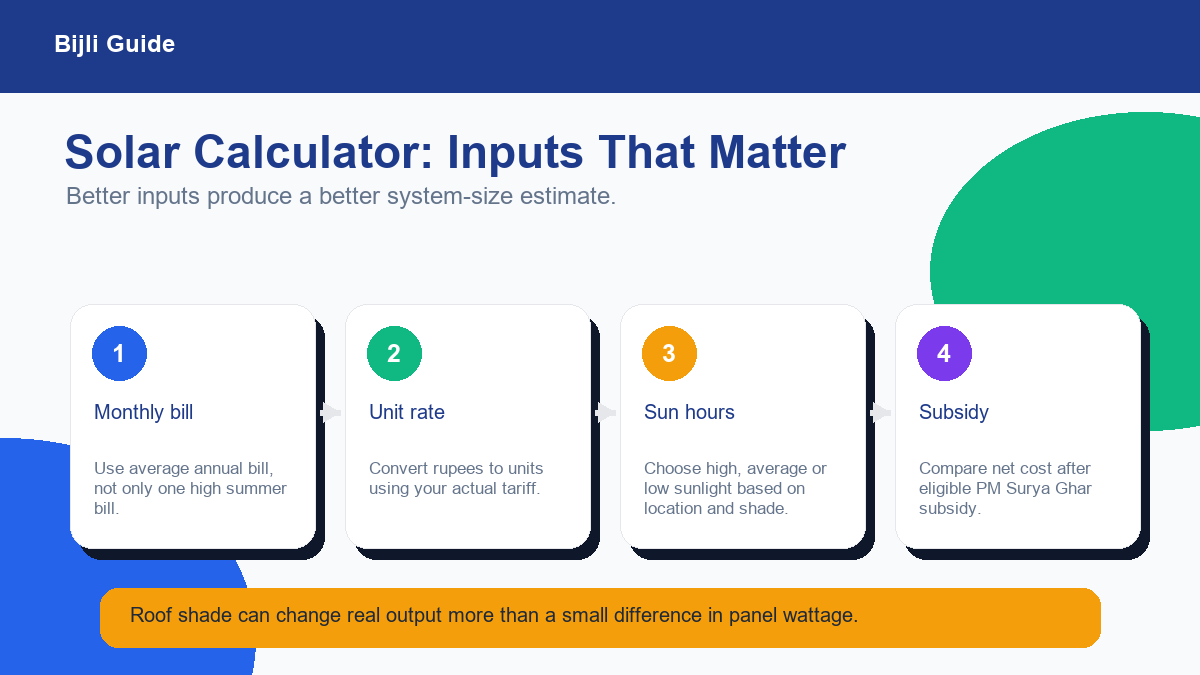
Use your average monthly bill from the last 12 months. If you only use a high summer bill, the system may be oversized.
Subsidy note
Government scheme values can change and state top-up subsidies may differ. The central figures used here match the widely published PM Surya Ghar structure of Rs 30,000 for 1 kW, Rs 60,000 for 2 kW, and Rs 78,000 for 3 kW or higher residential systems. Confirm final eligibility on the official portal or with your DISCOM before signing a vendor contract.
How This Solar Calculator Works
The calculator first estimates monthly units by dividing your average bill by the average unit rate. If your bill is Rs 2,400 and your average rate is Rs 8, your estimated monthly usage is 300 units. This is a planning number, not an official DISCOM reading.
Next, it estimates generation. A simple Indian planning rule is that 1 kW rooftop solar may generate around 3.5 to 4.5 units per day depending on roof direction, panel quality, city, season, and shade. At 4 units per day, 1 kW gives about 120 units per month.
Finally, the calculator estimates system cost, subsidy, net payable amount, and payback. Payback is simple: net cost divided by yearly bill savings. Real payback may change with tariff increases, degradation, maintenance, inverter replacement, net metering, and export rules.
Solar Size Examples
| Monthly Usage | Suggested System | Expected Monthly Generation | Typical Use Case |
|---|---|---|---|
| 120 units | 1 kW | About 120 units | Low-use home |
| 240 units | 2 kW | About 240 units | Small family home |
| 360 units | 3 kW | About 360 units | AC or pump usage |
| 600 units | 5 kW | About 600 units | Large home, EV, multiple ACs |
Important buying checks
Ask vendors for panel brand, inverter brand, warranty, structure quality, generation estimate, net metering support, total installed cost, subsidy process, and after-sales service. A cheap quotation can become expensive if mounting quality, earthing, wiring, or documentation is weak.
For official scheme context, review the PM India announcement for PM-Surya Ghar: Muft Bijli Yojana.
How To Decide The Right Solar Size
The best solar system is not always the biggest system the roof can hold. It should match your annual consumption, net metering rules, daytime export value, budget, and future appliance plans. A 3 kW system can be ideal for one family and too large for another if the second home uses little electricity during the year.
Start with the last 12 months of bills. Add the units and divide by 12. This smooths out AC-heavy summers, geyser-heavy winters, vacations, and festival months. If you are planning to add an EV, second AC, water pump, or electric cooking appliance, estimate those units separately and add them to the future monthly load before sizing the system.
Roof direction and shade can change the answer. South-facing shade-free roofs usually perform well in India, but east and west roofs can still be useful when the design is good. Avoid placing panels where water tanks, parapet walls, dish antennas, trees, or nearby buildings create shadows during generation hours. Even partial shade can reduce output from a panel string.
| Planning Question | Why It Matters | Practical Action |
|---|---|---|
| Is the roof shade-free? | Shade lowers generation and slows payback. | Check shadows between 9 AM and 4 PM. |
| Do you have enough annual units? | Oversizing can reduce financial return. | Use 12-month average units, not one bill. |
| Will appliances increase soon? | Future AC or EV use may justify more capacity. | Add expected new load before finalizing size. |
| Does your DISCOM allow net metering? | Export adjustment affects savings. | Confirm rules before vendor payment. |
When a smaller system is better
If your monthly bill is low, your roof has shade, or your DISCOM export rules are not favorable, a smaller system can give a cleaner payback. Many homes benefit from covering the expensive upper slabs rather than trying to erase every unit. Use this calculator to test 1 kW, 2 kW, 3 kW, and higher scenarios, then compare the net cost with realistic yearly savings.
What to ask before installation
Ask for a written generation estimate, panel datasheets, inverter warranty, structure material, earthing details, net metering responsibility, subsidy documentation process, and maintenance support. Good installation quality matters because rooftop solar has to survive heat, wind, rain, wiring stress, and many years of outdoor exposure.
Payback details most calculators ignore
Simple payback is useful, but it is not the whole story. Solar output slowly degrades, inverter replacement may be needed later, and savings depend on how your DISCOM adjusts exported units. On the positive side, electricity tariffs may rise over time, which can improve savings. Keep a conservative estimate when making a purchase decision: use realistic generation, include maintenance expectations, and do not assume every exported unit will always be valued the same as every imported unit.
After installation, compare the inverter app generation with your bill for the first few months. If generation is much lower than expected, check panel cleaning, shade, tripping, inverter errors, and whether the net meter was configured correctly.
Related Solar And Bill Tools
Frequently Asked Questions
How much solar do I need for a Rs 2000 electricity bill?
If your average unit rate is Rs 8, a Rs 2000 bill means about 250 units per month. A 2 kW rooftop solar system may generate around 240 units per month in many Indian locations.
How many units does 1 kW solar generate per day in India?
A practical planning estimate is 3.5 to 4.5 units per day per kW depending on state, season, roof direction, shade, and system quality.
What subsidy is available under PM Surya Ghar?
The central subsidy is commonly presented as Rs 30,000 for 1 kW, Rs 60,000 for 2 kW, and Rs 78,000 for 3 kW or higher residential systems, subject to scheme rules and eligibility.
Should I size solar from one monthly bill?
No. Use a 12-month average if possible. One summer bill or one winter bill can oversize or undersize the system.
Will solar make my bill zero?
It can reduce the energy charge strongly, but final bills may still include fixed charges, minimum charges, net metering rules, and state-specific adjustments.
How much roof space does rooftop solar need?
A rough estimate is 80 to 100 sq ft per kW, but actual space depends on panel wattage, roof layout, shade, and mounting design.