AC Electricity Bill Calculator
Estimate the monthly cost of running a 1 ton, 1.5 ton, or 2 ton AC in India. Compare inverter and non-inverter models, star ratings, usage hours, and unit rates.
Calculate AC Running Cost
Important note
This tool estimates average AC running cost. Real consumption can be higher or lower depending on room size, insulation, thermostat setting, outside temperature, servicing, and compressor cycling.
How AC Electricity Cost Is Calculated
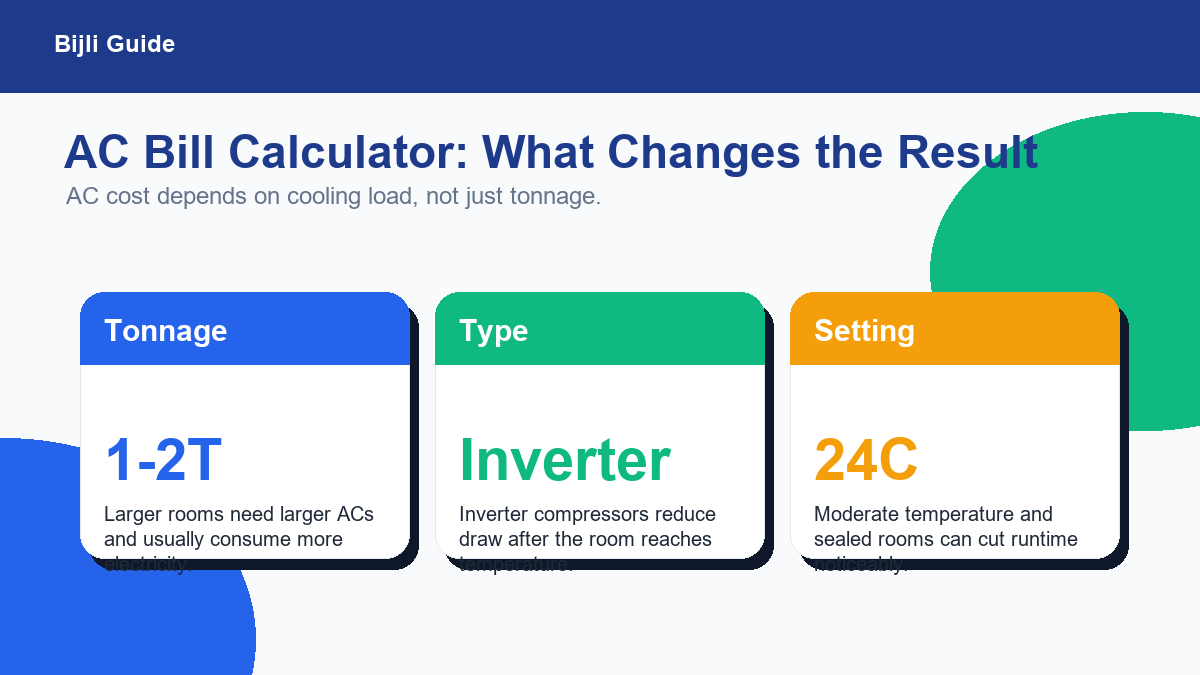
AC electricity cost depends on the average watts drawn while cooling. A fixed-speed AC may run near full load whenever the compressor is on. An inverter AC can start high and then reduce compressor speed once the room reaches the set temperature.
For practical planning, use this formula: average watts x hours x days / 1000 = monthly units. Then multiply monthly units by your electricity rate. This calculator estimates average watts from tonnage, compressor type, and star rating.
| AC Situation | Likely Bill Impact | What To Do |
|---|---|---|
| Set to 18 degree C | High | Use 24 degree C to 26 degree C after fast cooling. |
| Dirty filter | Medium to high | Clean filters every few weeks in summer. |
| Top-floor hot room | High | Use curtains, roof insulation, and correct AC size. |
| Inverter AC in sealed room | Lower | Keep doors closed and avoid heat leakage. |
How to reduce AC bill
Use the AC at 24 degree C, run a ceiling fan at low speed, close curtains before the room heats up, seal door gaps, clean filters, and service the unit before peak summer. If you are buying a new AC for daily use, compare the BEE label's annual energy consumption, not only the showroom price.
How To Get A More Realistic AC Estimate
AC power consumption is not as fixed as a bulb or fan. The compressor works harder when the room is hot, the outdoor temperature is high, the filter is dirty, or the set temperature is very low. It works less after the room stabilizes. This is why two 1.5 ton inverter ACs can show different bills in different homes even when both are 5-star rated.
For a better estimate, think about the room first. A top-floor bedroom with afternoon sun, single brick walls, and a large window may need more energy than a shaded room of the same size. A room with frequent door opening, poor sealing, or heat from kitchen equipment will also keep the compressor active for longer. If the room is oversized for the AC, the AC may run continuously and still not cool properly.
| Factor | Lower Consumption | Higher Consumption |
|---|---|---|
| Temperature setting | 24 degree C to 26 degree C | 18 degree C to 21 degree C |
| Room exposure | Shaded room, curtains, insulated roof | Top floor, direct sun, large glass |
| Maintenance | Clean filters and serviced coils | Dusty filters, low gas, poor airflow |
| AC type | Correctly sized inverter AC | Old fixed-speed AC or undersized unit |
3-star vs 5-star decision
A 5-star AC makes the most sense when the AC runs daily for long hours. In that case, lower power consumption can recover the higher purchase price over a few summers. A 3-star AC may still be practical for a guest room, short evening use, or a room where the AC is used only occasionally. The right choice depends on yearly hours, local tariff, and price difference.
Why your first hour can be expensive
The first hour often uses more power because the AC is cooling hot walls, furniture, curtains, and trapped air. Once the room reaches the set temperature, an inverter AC can slow down and consume less. This is why pre-cooling a room at 18 degree C and then leaving doors open wastes power. A steady setting, closed doors, and fan support usually give better comfort per unit.
Monthly AC bill scenarios
For a bedroom AC used eight hours at night, the monthly cost can look reasonable if the room is sealed and the unit is efficient. The same AC in a top-floor room with afternoon heat can use far more units. A living room AC can also cost more because doors open often, more people sit inside, and the room volume is larger. Shops and offices should be even more careful because AC use may run through the hottest part of the day.
Use the calculator twice when comparing behavior changes. First enter your current pattern, such as 18 degree C for 10 hours. Then enter a better pattern, such as 24 degree C for 8 hours with a ceiling fan. The difference between the two results is the monthly saving you can actually target. This is more useful than generic advice because it uses your tariff and your daily hours.
If you are buying a new AC, compare the BEE annual energy number for models of the same capacity. A 5-star model is not automatically the best value if the price difference is very high and usage is rare, but it can be the better long-term choice for daily summer use.
For rented homes, also check installation quality. Long copper pipe runs, weak outdoor airflow, poor drainage slope, and gaps around the indoor unit can reduce cooling performance. A well-installed 3-star AC can sometimes feel better and run fewer hours than a poorly installed higher-rated unit.
AC Guides To Read Next
Frequently Asked Questions
How much electricity does a 1.5 ton AC consume per hour?
A 1.5 ton AC can consume around 0.8 to 1.8 units per hour depending on inverter type, star rating, room heat, and temperature setting.
Why does inverter AC consumption vary?
An inverter AC changes compressor speed. It may draw high power in the first hour, then reduce power after the room cools.
Does 24 degree C save electricity?
Yes. Running the AC around 24 degree C to 26 degree C usually saves much more electricity than setting it at 18 degree C.
Is a 5-star AC always worth it?
A 5-star AC is usually worth it for daily long use. For rare guest-room use, the higher purchase price may not recover quickly.
Why is my AC bill higher than the calculator?
Top-floor heat, direct sunlight, dirty filters, open doors, poor installation, low gas, or very low temperature settings can increase actual consumption.
Should I use this calculator or the appliance calculator?
Use this AC calculator for air conditioners because it accounts for tonnage, compressor type, and star rating. Use the appliance calculator for simple fixed-watt devices.