Watts to kWh conversion
Watts to Units Calculator
Convert appliance watts into electricity units before you run a fan all night, buy a geyser, compare two ACs, or estimate the monthly cost of a new appliance.
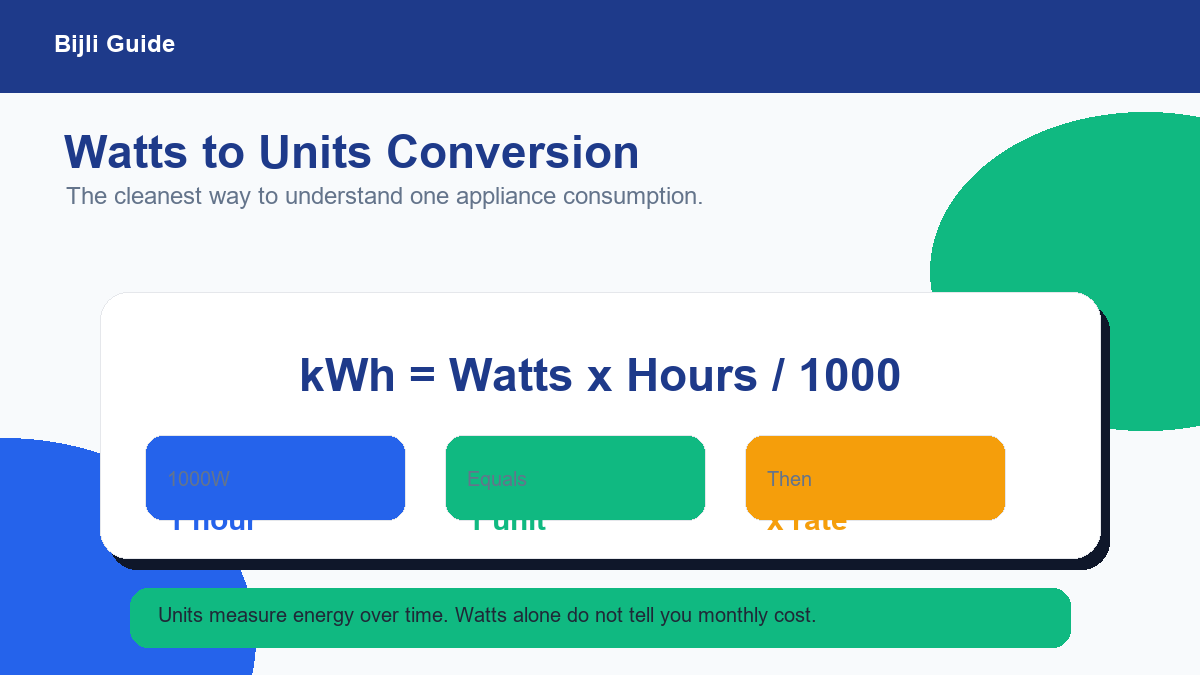
Convert Watts to Electricity Units
Enter the rated watts, daily usage hours, and number of days. For inverter appliances, use the average running watts if you know it.
Watts to Units Formula
The simple formula is units = watts x hours / 1000. A watt is a measure of power. A unit, or kWh, is a measure of energy used over time. This difference matters because an appliance with high wattage may not be expensive if it runs for a few minutes, while a smaller appliance can use many units if it runs all day.
For example, a 75 watt ceiling fan used for 12 hours consumes 75 x 12 / 1000 = 0.9 units per day. In a 30 day month, that becomes around 27 units. At Rs 8 per unit, the energy cost is about Rs 216 before fixed charges and taxes.
| Appliance | Typical Watts | Daily Use | Monthly Units |
|---|---|---|---|
| LED bulb | 9W | 6 hours | 1.6 units |
| Ceiling fan | 75W | 12 hours | 27 units |
| BLDC fan | 28W | 12 hours | 10.1 units |
| Electric geyser | 2000W | 30 minutes | 30 units |
| 1.5 ton AC | 1200W to 1800W | 8 hours | 288 to 432 units |
How to Use the Result for Your Electricity Bill
After converting watts to units, multiply the result by your electricity rate. If your fan uses 27 units in a month and your effective rate is Rs 8 per unit, the energy portion is roughly Rs 216. Your actual bill can still be higher because state electricity boards usually add fixed charges, slab differences, fuel adjustment charges, electricity duty, and sometimes meter rent.
For a quick home estimate, make a list of appliances that run for long hours: fans, lights, refrigerator, Wi-Fi router, TV, water purifier, air cooler, AC, geyser, water pump, and induction cooktop. Convert each appliance to units, add the monthly units together, then compare the total with the units printed on your bill. If your calculated number is much lower than the bill, check for hidden loads such as old refrigerators, long AC use, water pumps, or standby appliances that stay on throughout the day.
Common Mistakes When Reading Watts
Do not confuse watts with volts or amps. A label may show 230V because that is the voltage supply, but voltage alone does not tell you consumption. Some labels show current in amps; in that case, approximate watts can be found by multiplying volts and amps, but the exact value depends on power factor for some motors and compressors.
For appliances with compressors or thermostats, such as refrigerators and inverter ACs, the rated wattage is not always the constant running wattage. A refrigerator may start at a higher wattage and then cycle on and off. An inverter AC may begin at a high load and later reduce power after the room cools. For these appliances, the calculator is still useful, but the best estimate comes from average watts, BEE energy labels, or a plug-in energy meter.
Watts, Kilowatts, Units, and kWh Explained Simply
A kilowatt is 1000 watts. A kilowatt-hour means one kilowatt running for one hour. This is why a 1000 watt iron used for one hour consumes one unit, while a 500 watt appliance needs two hours to consume the same one unit. A 100 watt appliance needs ten hours to consume one unit.
This small distinction helps when comparing efficient appliances. A 28 watt BLDC fan looks only 47 watts lower than a 75 watt standard fan, but if the fan runs 12 hours daily, the monthly difference is about 16.9 units per fan. In a home with four fans, that becomes about 67 units per month. At Rs 8 per unit, that is around Rs 536 per month in energy difference during heavy fan usage months.
How To Read Appliance Labels Correctly
Most appliances show wattage as W on the label. A fan may show 75W, a tube light may show 20W, and a geyser may show 2000W. Some adapters show output in volts and amps instead of watts. For simple DC adapters, multiply volts by amps to estimate watts. For example, a 12V 2A adapter is about 24W. For motors and compressors, the exact draw can vary, so the label should be treated as a planning value.
Do not use maximum wattage for every appliance unless it really runs at that level all the time. A mixer grinder, washing machine, refrigerator, iron, and inverter AC can move up and down during use. A washing machine may draw high power while heating water or spinning, but lower power during wash movement. A refrigerator is powered all day but the compressor cycles. This is why BEE labels, annual energy consumption, or a plug-in energy meter can be more accurate for some appliances.
| Label Type | What It Means | How To Use It |
|---|---|---|
| Watts (W) | Power draw while running | Enter directly in the calculator. |
| Kilowatts (kW) | 1000 watts equals 1 kW | Multiply kW by 1000 before entering watts. |
| Annual units | Estimated yearly energy use | Divide by 12 for monthly units. |
| Volts and amps | Electrical supply and current | Use volts x amps as a rough watt estimate. |
Why this calculator is useful before buying
When comparing two appliances, do not look only at price. Convert the wattage difference into yearly units. A product that saves 40W may look minor, but if it runs 10 hours daily, it saves about 146 units per year. At Rs 8 per unit, that is around Rs 1,168 per year. This kind of calculation makes it easier to decide whether an efficient fan, refrigerator, pump, or AC is worth the higher upfront cost.
Frequently Asked Questions
How do I calculate units from watts?
Multiply the appliance wattage by the number of hours used, then divide by 1000. For monthly use, multiply the daily units by the number of days.
Are electricity units and kWh the same?
Yes. On Indian electricity bills, one unit usually means one kilowatt-hour, written as 1 kWh.
How many units does a 1000 watt appliance use in 1 hour?
A 1000 watt appliance running for 1 hour uses exactly 1 unit, because 1000 watts is equal to 1 kilowatt.
Why does the actual bill differ from this result?
The calculator estimates energy units only. Your final bill can also include slab rates, fixed charges, fuel adjustment, electricity duty, meter rent, and taxes.
Electricity Bill Calculator
Estimate your full bill from monthly units, fixed charges, and duty.
Appliance Cost Calculator
Convert watts and usage hours into rupees per day and month.
How to Calculate kWh
Read the full method with more appliance examples.
What Is 1 Unit?
Understand the unit shown on your electricity bill.