PM Surya Ghar Yojana: How Much Electricity Bill Can You Actually Save?
The PM Surya Ghar Muft Bijli Yojana is the largest rooftop solar push in Indian history. With a massive government subsidy of up to ₹78,000 and the promise of "300 units of free electricity," millions of homeowners are making the switch.
But cutting through the marketing hype—how much money does this actually save you every month? Let's break down the exact mathematics of solar generation, net metering, and the ROI (Return on Investment) you can expect.
Do this before calling an installer
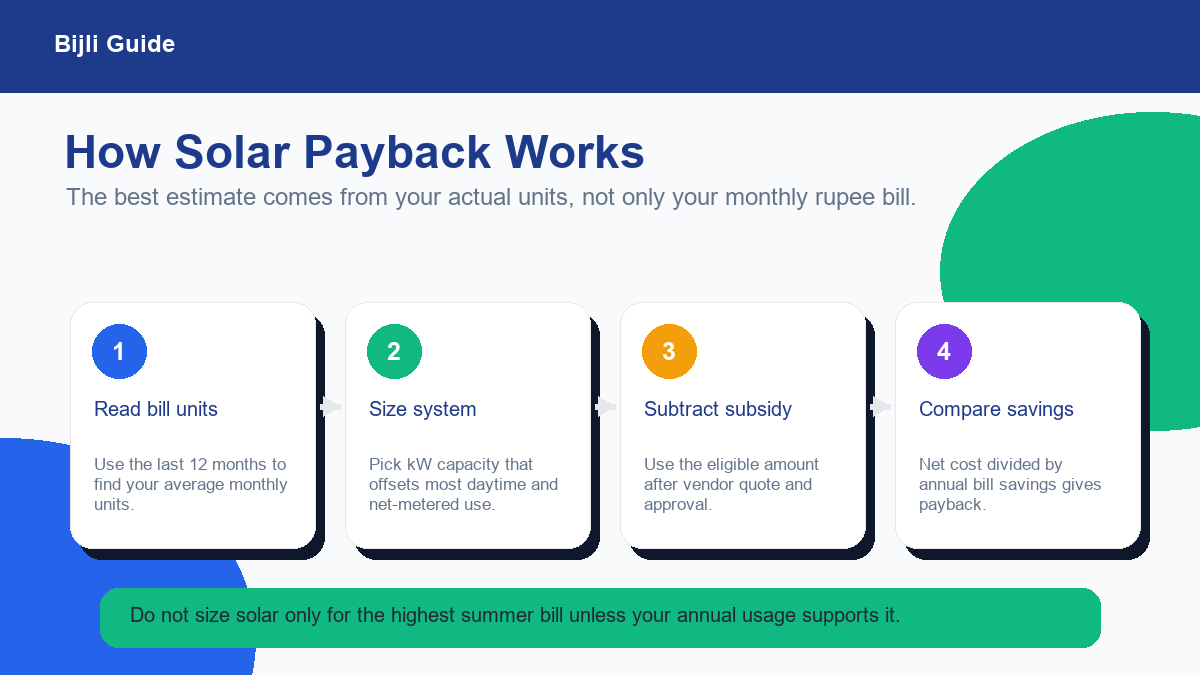
Keep 12 months of electricity bills ready and calculate your average monthly units. A solar quote based only on the highest summer bill can oversize the system, while a quote based only on a low winter bill can undersize it.
Also check if your roof has shade between 9 AM and 4 PM. Shade from a water tank, nearby building, or tree can reduce the real generation even if the system size looks perfect on paper.
Calculate Your Exact Solar Subsidy
Don't guess! We built a free calculator that tells you exactly how many panels you need to zero out your specific bill, and exactly how much government subsidy you will receive.
Use the Solar Calculator →How the "300 Free Units" Math Works
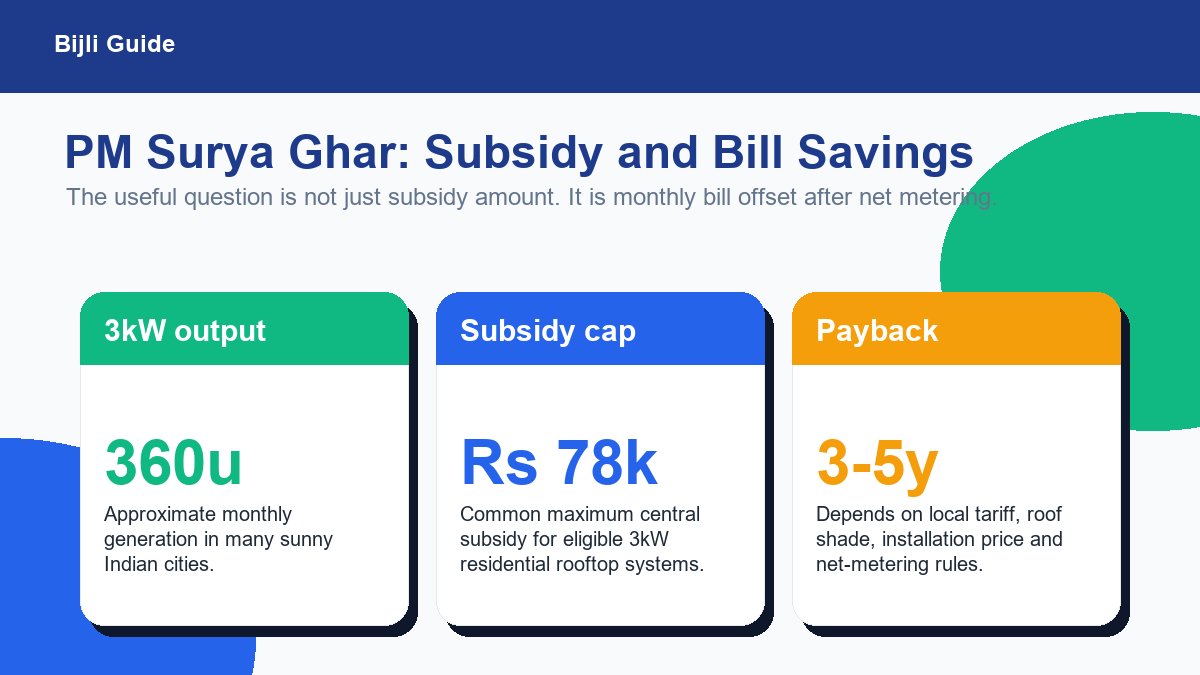
The core promise of the scheme is up to 300 units of free electricity. This is achieved through a standard 3 kW On-Grid Solar System.
In India, 1 kilowatt (kW) of solar panels generates roughly 4 units of electricity per day. Therefore, a 3 kW system generates:
- 3 kW × 4 units = 12 units per day
- 12 units × 30 days = 360 units per month
If your household consumes 300 units a month, your panels will generate 360 units. You will consume your 300 units for free, and the extra 60 units will be exported to your state grid (MSEDCL, UPPCL, BESCOM, etc.) via a Net Meter.
Monthly Savings Calculation
Let's look at the financial savings for a typical household consuming 300 units, assuming a tier-slotted average rate of ₹8 per unit.
| Metric | Without Solar | With 3kW Solar (PM Surya Ghar) |
|---|---|---|
| Monthly Consumption | 300 Units | 300 Units |
| Solar Generation | 0 Units | 360 Units |
| Net Billed Units | 300 Units | -60 Units (Credit) |
| Monthly Electricity Bill | ₹ 2,400 | ₹ 0 |
Total Annual Savings: ₹2,400 × 12 months = ₹28,800 saved per year!
Subsidy Structure (2026) & Payback Period
To install a high-quality 3 kW on-grid solar system, the market cost is roughly ₹1,80,000.
Under the PM Surya Ghar scheme, the government transfers the subsidy directly to your bank account after installation:
- Total Cost: ₹1,80,000
- Govt Subsidy: - ₹78,000
- Net Cost to You: ₹1,02,000
If you are saving ₹28,800 every year on your electricity bill, your Payback Period is ₹1,02,000 ÷ ₹28,800 = 3.5 Years. Since solar panels have a lifespan of 25 years, you will enjoy over 20 years of completely free electricity.
Will I pay absolutely nothing?
Almost nothing. Even if your energy usage is zero, electricity distribution boards (DISCOMs) charge a mandatory Fixed Charge or meter rent based on your sanctioned load (usually ₹100 - ₹300/month). Your bill will drop from thousands of rupees down to just this nominal fixed fee.
Frequently Asked Questions
What is PM Surya Ghar Muft Bijli Yojana?
It is a central government scheme launched in 2024 to provide up to 300 units of free electricity per month to 1 crore households by heavily subsidizing rooftop solar panel installations.
How much subsidy do I get for a 3kW solar system?
Under the new slab structure, the maximum subsidy is capped at ₹78,000 for a 3kW (or higher) system. For a 2kW system, it is ₹60,000.
Will my electricity bill become zero?
Yes, if your monthly consumption is under 300 units and you install a 3kW system, your generation will offset your usage, bringing your energy bill to zero (though you may still pay a small fixed meter charge).
Can I sell extra electricity back to the government?
Yes. Under the Net Metering policy, any extra electricity your solar panels generate is fed back into the grid, and the distribution company (DISCOM) will credit your account.