How Many Units Does a 1kW Solar Panel Generate per Day in India?
When planning to install a rooftop solar system—especially under the PM Surya Ghar Muft Bijli Yojana—the most important question homeowners have is: "Exactly how much electricity will my panels produce?"
Because your electricity bill is charged in Units (kWh), knowing the exact daily and monthly unit generation of a standard 1kW solar setup is critical to calculate your ROI.
The Quick Answer
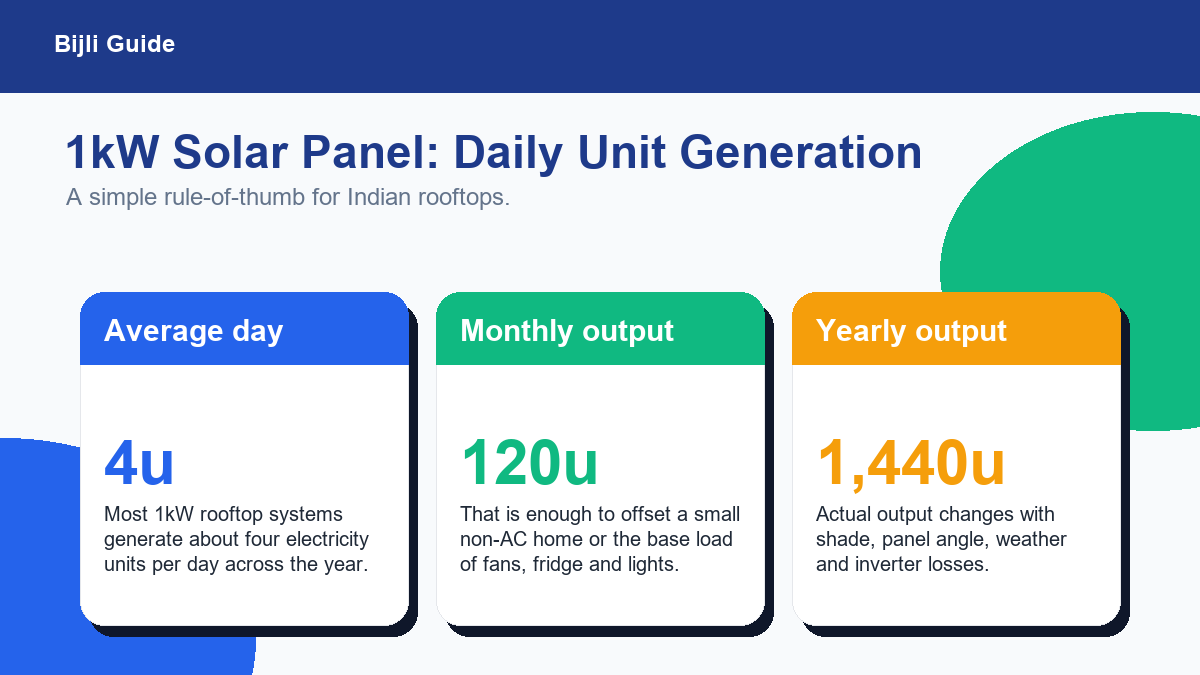
In India, a standard 1kW solar panel system generates an average of 4 Units (kWh) of electricity per day. This equals about 120 Units per month, or 1,440 Units per year.
Treat 4 units as a planning average
The 4-units-per-day rule is useful because it keeps the math simple, but it is not a performance guarantee. A clean, unshaded south-facing roof in Rajasthan or Gujarat can do better in summer. A shaded roof, wrong tilt, dusty panels, or long monsoon spell can do worse.
For buying decisions, compare the estimate with your own bill history. If your home uses 180 units a month, a 1kW system will help but probably will not make the bill zero.
Understanding the "4 Units a Day" Rule
Why exactly 4 units? India is blessed with excellent solar irradiance. Most states receive between 4 to 5 "Peak Sun Hours" per day.
- Peak Sun Hours: The hours of the day when the sun is directly overhead and panels operate at 100% efficiency.
- The Math: 1 kW system × 4 Peak Sun Hours = 4 kWh (which equals 4 Units of electricity).
Regional Variations
If you live in Rajasthan or Gujarat, high solar irradiance means your 1kW system might average 4.5 units a day. If you live in a cloudy region like the Northeast, it might average 3.5 units.
Monthly Savings from 1kW Solar
If a 1kW system generates 120 units a month, how much money does that save you?
Let's assume your state's electricity tariff is ₹8 per unit.
- Monthly Savings: 120 units × ₹8 = ₹960 / month
- Annual Savings: 1440 units × ₹8 = ₹11,520 / year
What Appliances Can 1kW Solar Run?
A common misconception is that a 1kW solar panel physically "runs" specific appliances. If you have an On-Grid system, the solar panels don't directly power an appliance. Instead, they feed electricity into your entire house grid.
However, to put 120 units/month into perspective, a 1kW solar panel generates enough electricity to completely offset the monthly running cost of:
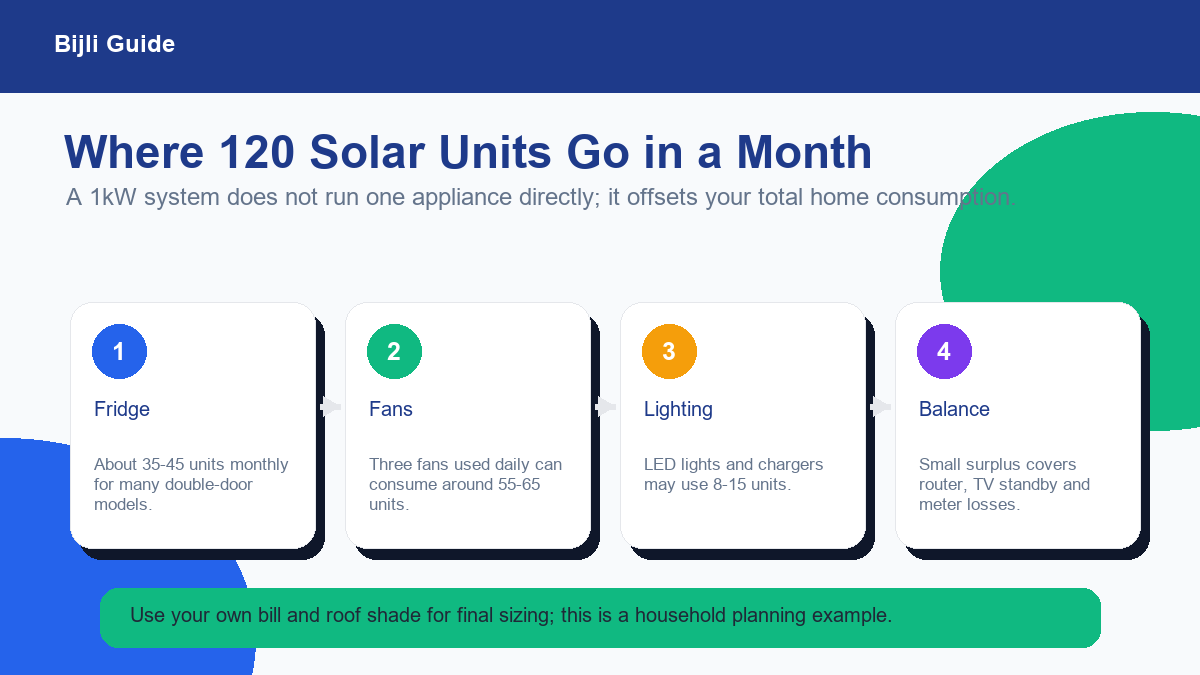
- A 3-star Double Door Refrigerator (runs 24/7 = 40 units/month)
- + Three Ceiling Fans running 12 hours a day (3 × 20 units = 60 units/month)
- + Five LED Tube Lights running 6 hours a day (10 units/month)
- Total: ~110 units
Scaling Up: 2kW and 3kW Systems
Because the math is linear, scaling up is easy to calculate:
| System Size | Daily Units | Monthly Units | Suitable For |
|---|---|---|---|
| 1 kW | 4 Units | 120 Units | Homes with no AC, standard appliances. |
| 2 kW | 8 Units | 240 Units | Homes with 1 Inverter AC running at night. |
| 3 kW | 12 Units | 360 Units | Homes with 2 ACs or heavy usage. |
Frequently Asked Questions
How many units does a 1kW solar panel generate in a day in India?
On average, a 1kW solar panel system in India generates 4 units (kWh) of electricity per day. This translates to roughly 120 units per month.
Does weather affect solar panel generation?
Yes. During peak summer, a 1kW system might generate 4.5 to 5 units per day. During monsoons or heavily cloudy winter days, it may drop to 2 or 3 units per day.
Can a 1kW solar system run a 1.5 Ton AC?
A 1.5 Ton AC consumes about 1.5 kW of power while running. A 1kW system cannot continuously run it alone without pulling extra power from the grid. However, the 120 units generated over the month will offset a significant portion of the AC's monthly running cost.