On-Grid vs Off-Grid Solar: Which Reduces Your Electricity Bill More?
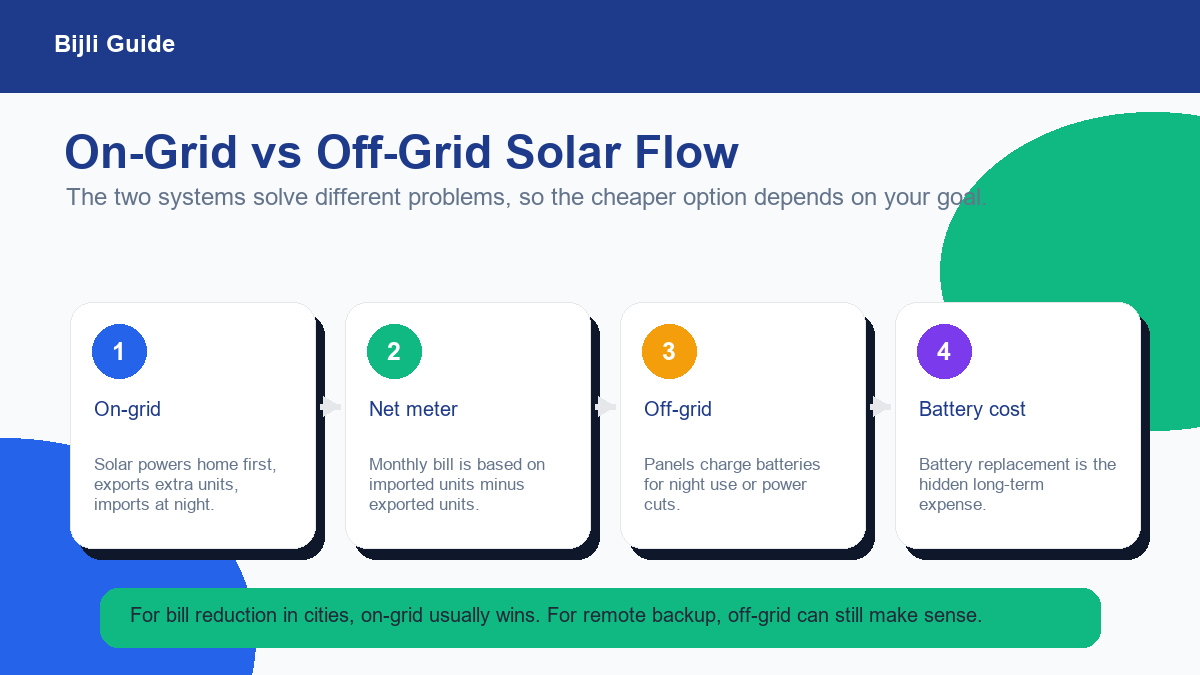
When deciding to install solar panels, you will immediately face a massive decision: Should you choose an On-Grid system or an Off-Grid system?
Choosing the wrong type could either disqualify you from government subsidies or leave you with an extremely expensive battery replacement bill a few years down the line. Let's break down how each system works and which one maximizes your electricity bill savings.
Pick the system based on the problem
If your goal is to reduce a normal city electricity bill, on-grid solar usually gives the cleaner payback because it avoids battery cost and can use net metering. If your real problem is long power cuts, off-grid or hybrid solar may be worth considering even if the financial return is weaker.
Before accepting a quote, ask the installer one direct question: "Is this system designed to reduce my bill, provide backup during cuts, or both?" The answer should match the hardware they are selling.
1. On-Grid Solar Systems (Grid-Tied)
An On-Grid system is physically wired into your state electricity grid (like MSEDCL, UPPCL, etc.). It has no batteries.
How it works:
- During the day, your panels generate electricity. Your home uses this electricity first.
- If you generate more power than your home is using (e.g., you are at the office), the extra electricity is automatically sent into the city grid.
- A Net Meter spins backwards to credit your account for the power you gave to the grid.
- At night, since you have no batteries, you pull electricity from the grid just like a normal house. At the end of the month, you only pay for your Net Usage (Grid Units Imported - Solar Units Exported).
The Subsidy Advantage
The highly popular PM Surya Ghar Muft Bijli Yojana (providing up to ₹78,000 in subsidies) is strictly designed for On-Grid systems because the government wants your excess daytime power to help stabilize the national grid.
2. Off-Grid Solar Systems
An Off-Grid system operates entirely independently. It is not connected to the city grid.
How it works:
- During the day, panels power your home and simultaneously charge a massive bank of Solar Batteries.
- At night, your home draws power from the batteries.
- If the batteries run out, your home loses power.
Financial Comparison: Which saves more money?
If your sole goal is to reduce your electricity bill and get the best Return on Investment (ROI), the answer is overwhelmingly On-Grid Solar.
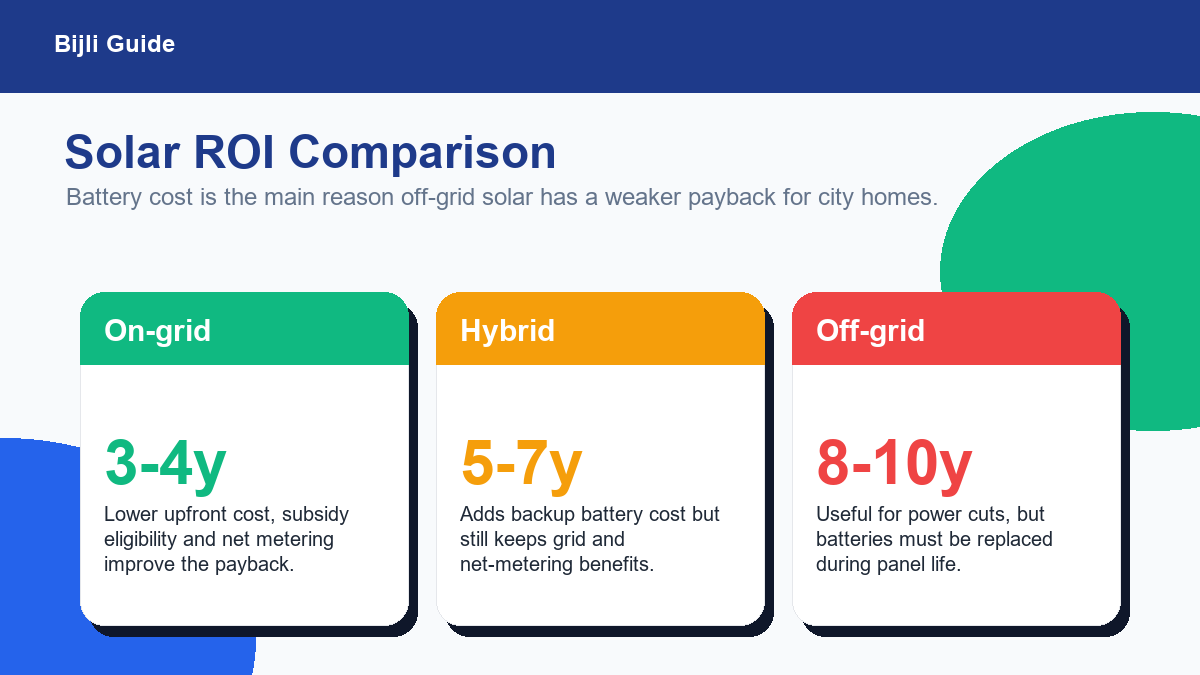
Here is why Off-Grid systems make terrible financial sense for city-dwellers:
- No Government Subsidy: Off-Grid systems do not qualify for the PM Surya Ghar subsidy.
- Insane Initial Costs: High-capacity Lithium-ion or Tubular batteries double the upfront cost of your solar installation.
- Replacement Costs Destroy ROI: Solar panels last 25 years. Batteries only last 5 to 7 years. You will have to buy brand new batteries 3 or 4 times during the lifespan of your panels. This completely destroys any money you saved on your electricity bill.
| Feature | On-Grid Solar | Off-Grid Solar |
|---|---|---|
| Primary Goal | Reduce Electricity Bills | Survive long power cuts |
| Battery Required? | No | Yes (Expensive) |
| Eligible for Subsidy? | Yes (Up to ₹78,000) | No |
| Payback Period (ROI) | 3 to 4 Years | 8 to 10 Years |
What is Hybrid Solar?
A Hybrid system is a mix of both. It is connected to the grid (so you get Net Metering) but also includes a small battery backup. If the grid fails, the battery keeps your lights on.
While Hybrid systems give you the "best of both worlds," they are the most expensive type of system to install. Only opt for Hybrid if you live in an area with frequent 4+ hour power cuts.
Frequently Asked Questions
What is an On-Grid solar system?
An On-Grid system is connected directly to your state's electricity grid. It doesn't use batteries. Extra electricity generated during the day is sent to the grid via a net meter, and you draw from the grid at night.
Does PM Surya Ghar subsidy apply to Off-Grid solar?
No. The PM Surya Ghar Muft Bijli Yojana subsidy is strictly for residential On-Grid (or Hybrid systems without battery subsidies) that utilize net metering.
Why are Off-Grid systems more expensive?
Off-Grid systems require heavy-duty solar batteries to store electricity for nighttime use. Lithium-ion or tubular lead-acid batteries are expensive and must be replaced every 5 to 10 years, drastically lowering your ROI.
Do On-Grid systems work during a power cut?
No. For safety reasons (anti-islanding), an On-Grid inverter automatically shuts off if the main power grid goes down, preventing electricity from flowing into dead power lines and injuring linemen.