Appliance Electricity Cost Calculator
Find how many units a home appliance consumes and what it costs per day, per month, and per year. Use it before buying or to identify which appliance is increasing your bill.
Calculate Appliance Cost
How To Use This Calculator Correctly
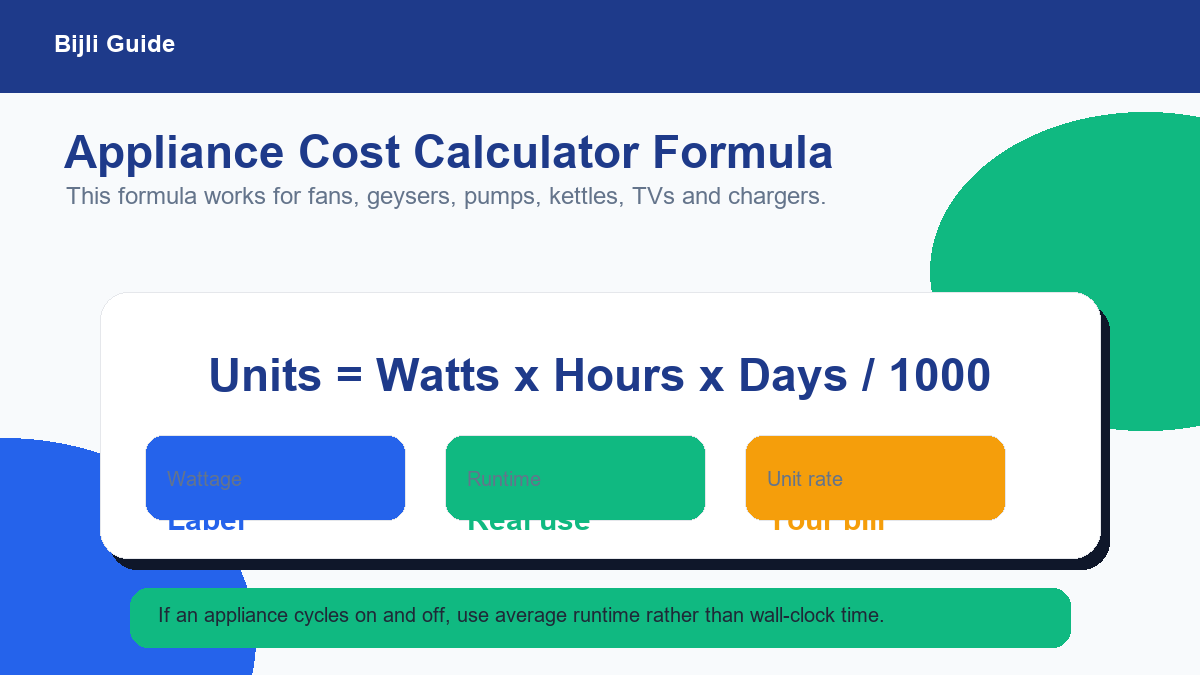
Every appliance has a power rating in watts. Wattage tells you how much power the appliance draws when it is running. Your bill is based on energy used over time, so the calculator multiplies watts by hours and days, then converts the result into units.
The biggest mistake is using plugged-in time instead of actual running time for cycling appliances. A refrigerator may be plugged in all day, but the compressor does not run continuously. A geyser may be switched on for 40 minutes, but the heating element may cut off once the water is hot. An iron may be used for one hour, but it cycles through a thermostat.
| Appliance | Typical Wattage | What To Enter |
|---|---|---|
| Ceiling fan | 30W to 80W | Actual daily running hours |
| Electric geyser | 2000W | Heating minutes converted to hours |
| AC | 700W to 1800W average | Use AC calculator for better estimate |
| Refrigerator | 100W to 250W average | Use annual units if label provides it |
How to find hidden high-cost appliances
Start with high wattage appliances and appliances used for long hours. A 20W light used for six hours is small. A 2000W geyser used for 45 minutes is not small. A 75W fan used all day can become expensive because the hours are high. Use this tool to test each appliance one by one, then compare monthly units.
Appliance Cost Examples For Indian Homes
The same appliance can cost very different amounts in two homes because usage hours and tariff slabs change the final number. A geyser used by one person for 15 minutes daily is manageable. The same geyser used by a family for 90 minutes daily can become one of the largest loads in the home. A normal fan looks small at 75W, but in summer it may run 12 to 18 hours daily across several rooms.
Use the examples below as a starting point, then replace the wattage and hours with your real values. The goal is not to memorize one number. The goal is to understand which appliances deserve attention when the bill rises.
| Appliance Scenario | Units Per Month | Cost at Rs 8/unit | What It Means |
|---|---|---|---|
| 75W fan, 12 hours/day | 27 units | Rs 216 | One fan is moderate; multiple fans add up. |
| 30W BLDC fan, 12 hours/day | 10.8 units | Rs 86 | Best savings when fans run long hours. |
| 2000W geyser, 45 minutes/day | 45 units | Rs 360 | Runtime control matters more than brand. |
| 1200W room heater, 4 hours/day | 144 units | Rs 1,152 | Heating appliances can raise winter bills quickly. |
How to prioritize savings
Sort appliances by monthly units, not by wattage alone. A high-wattage mixer used for five minutes is not a bill problem. A medium-wattage fan used all night can matter more. Focus first on ACs, geysers, heaters, old refrigerators, pumps, and appliances used for long hours. After that, look at smaller upgrades such as LED lighting and standby load reduction.
Use the calculator before buying
Before buying a new appliance, compare the purchase price with yearly running cost. A cheaper appliance can become expensive if it wastes electricity every day. This is especially true for fans, refrigerators, ACs, pumps, and water heaters because they stay in service for years. If a more efficient model saves Rs 1,000 to Rs 3,000 per year, the higher purchase price may recover faster than expected.
Room-by-room electricity audit
If the bill is high and you do not know why, walk through the home and make a short list for each room. In bedrooms, count fans, lights, ACs, chargers, and heaters. In the kitchen, check refrigerator age, mixer use, microwave use, induction cooking, chimney, and water purifier. In bathrooms, note geyser wattage and heating time. In utility areas, check washing machine, pump, iron, and any always-on devices.
Then enter each major item in the calculator and write down monthly units. This method usually exposes the real problem faster than guessing. A family may discover that one old refrigerator and one long-running geyser are costing more than all lighting combined. Another home may find that several normal fans running all night are a bigger monthly load than expected.
After the audit, group changes into easy wins and purchase decisions. Easy wins include reducing geyser runtime, cleaning AC filters, using timer plugs where appropriate, and switching off standby loads. Purchase decisions include BLDC fans, efficient refrigerators, inverter ACs, or solar if the annual units justify it.
Keep the audit simple enough to repeat. Recheck after one billing cycle and compare the new units with the old bill. If units fall, the change worked. If units do not fall, the real load is somewhere else or the billing period changed. This practical loop is more useful than relying on one-time guesses, especially in homes where seasonal AC, geyser, or pump usage changes every few months.
Popular Appliance Guides
Frequently Asked Questions
How do I calculate appliance electricity cost?
Multiply appliance watts by daily hours and monthly days, divide by 1000 to get units, then multiply units by your electricity rate.
Where can I find appliance wattage?
Check the label on the appliance body, plug adapter, back panel, BEE label, user manual, or product specification sheet.
Why does refrigerator wattage not mean full-day consumption?
A refrigerator compressor cycles on and off. Use average running time or rated annual units for a better estimate.
Which appliances usually cost the most?
ACs, geysers, room heaters, water pumps, induction cooktops, old refrigerators, and high-use fans usually create the biggest bill impact.
What rate per unit should I use?
Use the effective rate from your bill if possible. If unsure, Rs 7 to Rs 10 per unit is a practical range for many urban residential estimates.
Can this calculator compare two appliances?
Yes. Run the calculator twice with different wattage values, such as a 75W normal fan and a 35W BLDC fan, then compare monthly and yearly cost.