1.5 Ton AC Electricity Consumption per Hour in India
A 1.5 ton AC is one of the most common air conditioner sizes in Indian homes. It is usually bought for bedrooms, medium living rooms, home offices, rented flats, and small shops. It is also one of the biggest electricity users in the house. A fan may run all day, a fridge may run all month, and a geyser may draw high power for a short time, but a 1.5 ton AC can change the summer bill faster than almost anything else.
The difficult part is that there is no single answer to the question, "How many units does a 1.5 ton AC consume per hour?" Two ACs with the same tonnage can have very different consumption. A fixed-speed window AC, a 3 star non-inverter split AC, a 3 star inverter split AC, and a 5 star inverter split AC all cool the room, but they do not use electricity in the same way.
This guide explains the real calculation in simple terms. You will see per hour, per night, and monthly examples, plus the practical reasons why your actual bill may be higher or lower than the number printed on the product page.
Quick Answer
A 1.5 ton non-inverter AC usually consumes about 1.4 to 1.8 units per hour while the compressor is running. A 1.5 ton inverter AC may consume about 0.8 to 1.2 units in the first hour and then drop lower once the room reaches the set temperature. For an 8 hour night, a practical estimate is 5 to 8 units for a good inverter AC and 8 to 12 units for an older or inefficient AC.
What Does 1.5 Ton Mean?
The "1.5 ton" rating is a cooling capacity rating, not an electricity bill rating. It tells you how much heat the AC can remove from a room. It does not mean the AC consumes 1.5 units every hour in all conditions. A 1.5 ton AC can have a rated input power near 1,200W, 1,500W, 1,800W, or even variable power depending on the model.
In simple terms, tonnage is about cooling strength. Wattage is about electricity use. Your bill depends on wattage and running time. If a 1,500W AC runs at full load for one hour, it consumes 1.5 units. If an inverter AC reduces its compressor speed and runs at 700W for one hour, it consumes 0.7 units.
Formula
Units consumed = Watts x Hours used / 1000
Example: 1500W x 8 hours / 1000 = 12 units. If the compressor runs only half the time, actual units may be closer to 6 units.
1.5 Ton AC Power Consumption Table
The table below gives practical ranges for Indian homes. Treat these as estimates, not promises. Actual results depend on outdoor temperature, room size, insulation, sunlight, door gaps, filter condition, and set temperature.
| 1.5 Ton AC Type | Typical Input Power | Likely Units in 8 Hours | Approx Night Cost at Rs 8/unit |
|---|---|---|---|
| Old window AC | 1600W to 1900W | 9 to 12 units | Rs 72 to Rs 96 |
| 3 star fixed-speed split AC | 1450W to 1700W | 8 to 10 units | Rs 64 to Rs 80 |
| 3 star inverter split AC | 500W to 1600W variable | 6 to 8 units | Rs 48 to Rs 64 |
| 5 star inverter split AC | 350W to 1500W variable | 5 to 7 units | Rs 40 to Rs 56 |
Why First Hour Consumption Is Higher
The first hour of AC use is usually the most expensive hour. When you switch on the AC, the room is hot. The walls, bed, curtains, floor, furniture, and even the air trapped inside wardrobes may be warm. The AC is not only cooling the air; it is pulling heat out of everything in the room.
This is why an inverter AC may start near its higher wattage range. For example, it may draw 1,200W to 1,600W in the beginning. After the room reaches 24 degree C or 25 degree C, the compressor slows down. At that point the AC is not doing heavy cooling. It is maintaining temperature. That maintenance stage can be much cheaper than the first cooling stage.
Fixed-speed non-inverter ACs behave differently. They run at full power until the room reaches the set temperature, then the compressor switches off. When the room warms up again, the compressor starts again at full power. This repeated on-off cycle is less smooth and often less efficient, especially in rooms with heat leakage.
Monthly Bill Examples For Different Usage Patterns
Most people do not use their AC in a laboratory pattern. Some run it for two hours before sleeping. Some run it all night. Some use it only during May and June. Some use it from March to September. To estimate your own bill, first decide your daily pattern.
| Usage Pattern | Daily Units Estimate | Monthly Units | Monthly Cost at Rs 8/unit |
|---|---|---|---|
| 2 hours evening use | 2 to 3 units | 60 to 90 units | Rs 480 to Rs 720 |
| 6 hours night use | 4 to 6 units | 120 to 180 units | Rs 960 to Rs 1,440 |
| 8 hours night use | 5 to 8 units | 150 to 240 units | Rs 1,200 to Rs 1,920 |
| 12 hours heavy use | 8 to 12 units | 240 to 360 units | Rs 1,920 to Rs 2,880 |
Why Your Actual AC Bill May Be Higher
If your bill looks much higher than the estimate, do not assume the calculator is wrong immediately. AC bills rise because of several small issues that add up.
Room size: A 1.5 ton AC is commonly used for rooms around 120 to 180 sq ft, but room height, sunlight, glass area, and wall heat matter. A top-floor bedroom under a hot roof may behave like a much larger room. A west-facing room with direct afternoon sun may need more cooling than a shaded room of the same size.
Set temperature: Running at 18 degree C is very different from running at 24 degree C. The lower you set the temperature, the longer the compressor works. Many people set 18 degree C for fast cooling and forget to raise it later. That habit can add hundreds of units across a summer season.
Door leakage: Cold air is heavier than warm air. If there is a big gap under the door, cooled air escapes into the corridor. The AC then keeps working to cool replacement warm air. Even a simple door bottom seal can help in some rooms.
Dirty filters: A blocked filter reduces airflow. The room cools slowly, the compressor works longer, and users keep lowering the temperature. Cleaning the filter every few weeks during summer is one of the cheapest ways to protect both comfort and bill.
Outdoor unit airflow: For split ACs, the outdoor unit must release heat. If it is trapped in a closed balcony or blocked by dust, plants, or grills, efficiency falls. The indoor unit may look fine, but the system uses more power to deliver the same cooling.
Best Temperature Setting For Indian Summers
For most bedrooms, 24 degree C to 26 degree C is a practical range. At 24 degree C, many people feel comfortable while the AC still has a chance to cycle down or reduce compressor speed. At 26 degree C with a ceiling fan at low speed, the room can feel cooler than the number suggests because air movement improves comfort.
A good routine is simple: start at 24 degree C, use turbo mode only for a short time if the room is extremely hot, then switch to normal or sleep mode. If you wake up feeling cold at night, your AC was probably set lower than needed. That is wasted electricity.
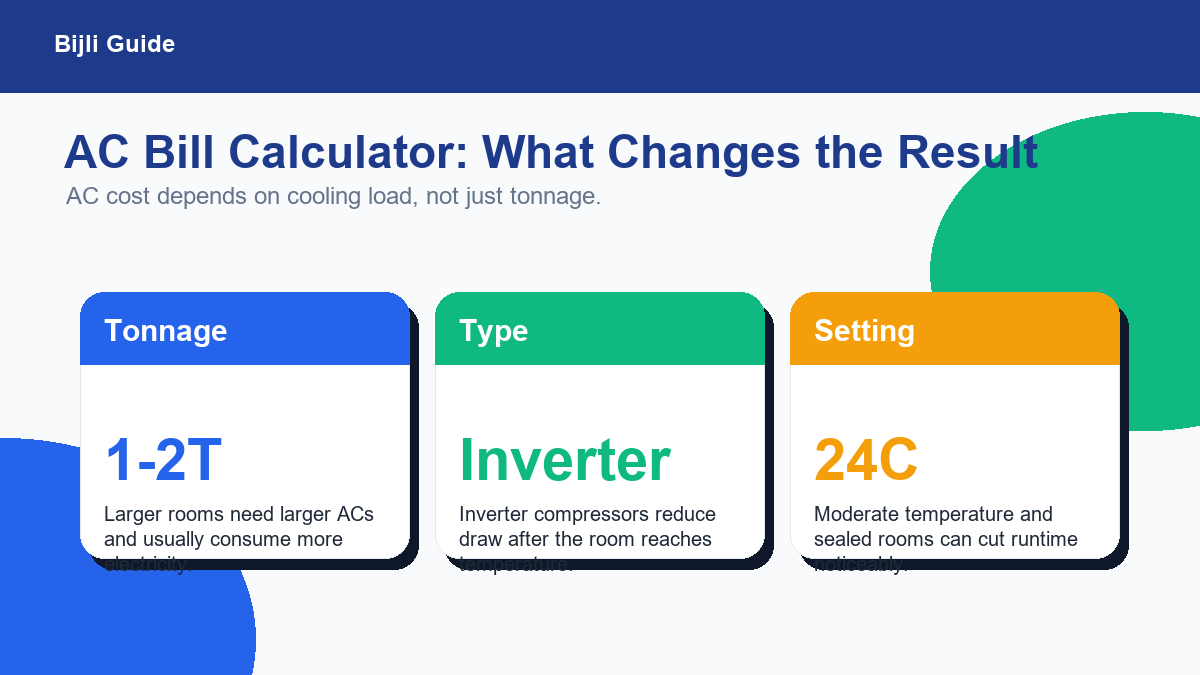
1.5 Ton AC Inverter vs Non-Inverter: Practical Difference
An inverter AC does not mean it runs on a home inverter battery. In this context, inverter means the compressor speed can vary. Instead of only "on" and "off", it can speed up, slow down, and maintain cooling more smoothly.
This matters because a bedroom does not need full cooling power all night. After the initial cooling, it only needs enough power to remove new heat entering the room. In a sealed room, a good inverter AC can reduce electricity use strongly after the first hour. In a leaky room, the compressor has to keep working because new heat keeps entering.
A non-inverter AC can still be useful if usage is rare and purchase budget is tight, but for daily night use in a hot city, an inverter model usually gives better comfort and lower running cost.
How To Read The BEE Label Before Buying
Do not look only at star count. Look at the annual energy consumption number printed on the label. BEE star labels are meant to help buyers compare energy efficiency. The official BEE star labelling programme describes star rating as an ascending efficiency scale from 1 to 5, where higher star levels indicate better efficiency for registered products.
When comparing two 1.5 ton ACs, check the annual units on the label, the ISEER value, the label period, and whether both models have the same capacity category. A 5 star model with a clearly lower annual kWh number can save money year after year if the AC is used heavily.
You can read more about the official programme on the Bureau of Energy Efficiency star labelling page.
When A 1.5 Ton AC Is The Wrong Size
Buying the wrong size can waste electricity. If the room is too small and the AC is oversized, it may cool quickly but not run long enough to remove humidity properly. The room may feel cold and clammy. If the room is too large and the AC is undersized, the compressor may run continuously and still fail to cool the room well.
For many normal bedrooms, 1.5 ton is suitable. But for very small rooms, 1 ton may be enough. For large halls, open-plan spaces, top-floor rooms with strong sunlight, or rooms with large glass windows, 1.5 ton may not be enough. In those cases, the AC works harder and the bill rises without giving proper comfort.
How To Reduce 1.5 Ton AC Electricity Consumption
- Use 24 degree C as the normal setting: Use lower temperatures only for short fast-cooling periods.
- Use a ceiling fan at low speed: Air movement helps the room feel cooler at 25 degree C or 26 degree C.
- Clean filters regularly: A dirty filter reduces airflow and increases compressor running time.
- Close curtains before the room heats up: Preventing heat entry is cheaper than removing heat later.
- Seal door gaps: This is especially useful in bedrooms where cold air escapes under the door.
- Service before peak summer: Low gas, dirty coils, and blocked drainage can all hurt cooling and efficiency.
- Do not cool empty rooms: Switch off early or use timer mode if you leave the room.
Frequently Asked Questions
How many units does a 1.5 ton AC consume in 1 hour?
A 1.5 ton non-inverter AC can consume around 1.4 to 1.8 units per hour while the compressor is running. A modern inverter AC may use around 0.8 to 1.2 units in the first hour and often less after the room cools.
How many units does a 1.5 ton AC consume in 8 hours?
For an 8 hour night, a 1.5 ton inverter AC commonly uses around 5 to 8 units depending on temperature setting, room insulation, outside heat, and star rating. An older non-inverter model may use 8 to 12 units.
Is 24 degree C better than 18 degree C for AC savings?
Yes. A 24 degree C setting usually gives a much better balance of comfort and electricity savings. At 18 degree C, the compressor works harder for longer and the bill rises sharply.
Does an inverter AC always save electricity?
An inverter AC saves the most when the room is reasonably sealed and the AC runs for several hours. If the door is open, the room is oversized, or the filter is blocked, savings drop.
Can a 1.5 ton AC run on a normal home connection?
Most Indian homes can run one 1.5 ton AC if wiring, socket, MCB, and sanctioned load are suitable. For multiple ACs, old wiring, or frequent tripping, ask a qualified electrician to check the load.
What is the monthly cost of a 1.5 ton AC in India?
If the AC uses 6 units per night and the unit rate is Rs 8, it costs about Rs 48 per night. For 30 nights, that is about Rs 1,440 before fixed charges, duty, and other bill components.
Calculate Your Exact AC Bill
Use the AC electricity bill calculator to enter your daily hours, inverter type, star rating, and unit rate. It gives a better estimate than using a single average number for every home.
Use the AC Cost Calculator