Electricity Bill Calculator India
Estimate your monthly electricity bill from consumed units, per-unit rate, fixed charges, and electricity duty. Use it for quick bill checks, rent discussions, appliance planning, or comparing usage before and after summer.
Calculate Your Bill
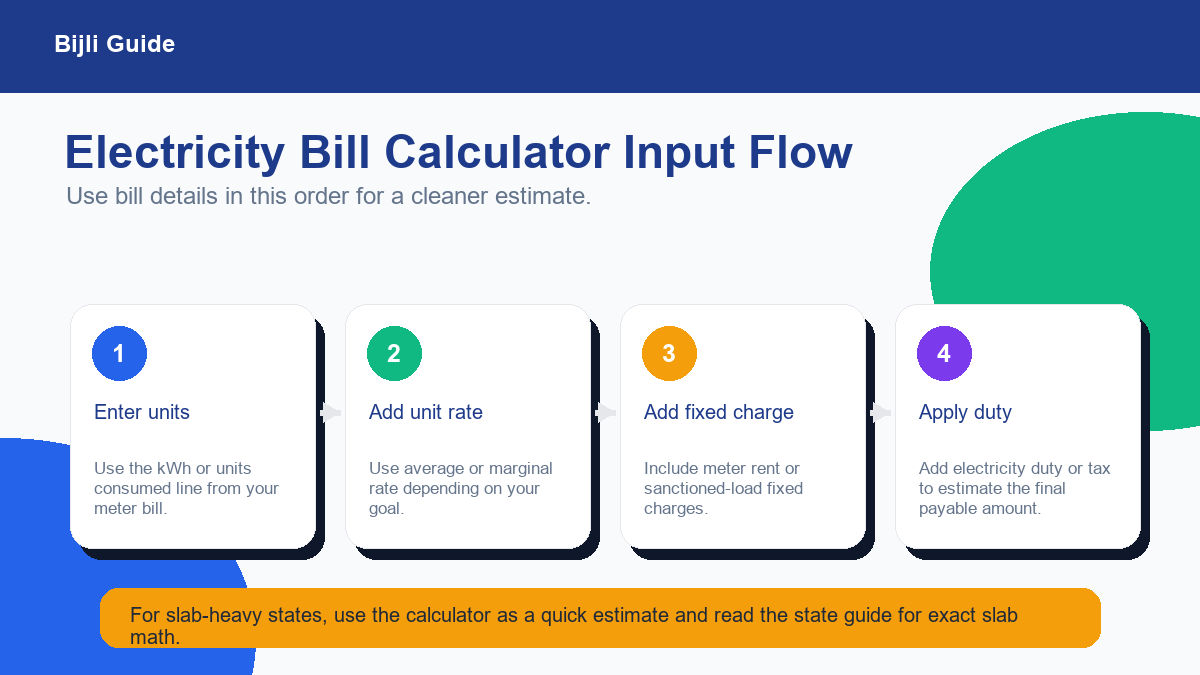
Use the values printed on your bill. If your bill has slabs, enter the average energy rate.
Use this as an estimate, not a replacement for your DISCOM bill
Indian electricity bills can include slab rates, fixed charges, duty, fuel adjustment, meter rent, subsidy, arrears, and rounding. This calculator is strongest when you want to understand the main cost drivers quickly. For exact billing, compare the result with your state or DISCOM tariff.
How Electricity Bills Are Calculated In India
The main line item in most electricity bills is the energy charge. This is based on how many units you used. One unit means one kilowatt-hour. If a 1000W appliance runs for one hour, it consumes one unit. If a 100W appliance runs for ten hours, that also consumes one unit.
The bill rarely stops there. Many Indian electricity providers add fixed charges based on connected load, meter type, or consumer category. Some states apply electricity duty or tax. Some bills include fuel adjustment charges, power purchase adjustment, arrears, late payment surcharge, or subsidy adjustments.
This is why two homes using the same 250 units may not pay the same final bill. The state, DISCOM, tariff category, sanctioned load, subsidy rules, and slab structure all matter.
Example Calculation
| Bill Item | Example | Amount |
|---|---|---|
| Energy charge | 250 units x Rs 7.50 | Rs 1,875 |
| Fixed charge | Monthly load charge | Rs 150 |
| Electricity duty | 10 percent of energy charge | Rs 187.50 |
| Total estimate | Energy + fixed + duty | Rs 2,212.50 |
When Your Bill Suddenly Increases
First check whether units increased or whether the rate per unit changed. If units increased, the reason is usually appliance usage: ACs, geysers, room heaters, water pumps, refrigerators, or EV charging. If units stayed similar but the bill increased, check fixed charges, duty, fuel adjustment, arrears, or whether subsidy was removed.
For high bills, do not guess. Use the appliance cost calculator to estimate each major appliance and compare the total with your meter units.
How To Choose Accurate Inputs
The easiest way to use this calculator is to copy values from your latest electricity bill. Start with the consumed units for the billing period. If your bill is for 60 days, divide the units by two before using the calculator for a monthly estimate. If the bill is for 28 or 32 days, the result will still be close enough for planning, but a daily average will be more accurate.
The unit rate needs more care. Many Indian residential bills use slabs, so the first block of units is cheaper and later units are charged at a higher rate. If you enter only the lowest slab rate, your estimate will look too low. A practical shortcut is to divide the energy charge by consumed units. This gives a blended energy rate that reflects the slabs used in that bill.
Fixed charges are different from energy charges. They may depend on sanctioned load, meter category, phase type, or connection type. A low-usage home can still receive a bill because fixed charges and minimum charges remain even when energy use is low. This is why a solar home may still receive a monthly bill even if net units are close to zero.
| Input | Where To Find It | Common Mistake |
|---|---|---|
| Units | Look for kWh, consumed units, or billed units. | Using current meter reading instead of monthly consumed units. |
| Rate per unit | Energy charge divided by consumed units. | Using only the first slab rate for the whole bill. |
| Fixed charge | Fixed/demand/load charge line item. | Ignoring fixed charge when comparing bills. |
| Duty or tax | Electricity duty or tax line on the bill. | Adding tax twice when the total already includes it. |
What is a good result?
A good result is not just a lower total. A good result explains why the bill is high. If the effective rate is high, you may be crossing expensive slabs. If daily cost is high only in summer, AC usage is the main suspect. If the bill is high even with low units, look at fixed charges, arrears, or duty. Use the calculator as a reading tool: it turns the bill into smaller parts so you know what to change.
Monthly bill review checklist
When a bill looks wrong, compare it with the same month last year instead of only the previous month. Summer AC use, winter geyser use, guests, work-from-home hours, and water pump use can change the pattern. Check whether the billing period has more days than usual, whether an arrear was added, and whether the meter reading is actual or estimated. Then compare daily units: monthly units divided by billed days. Daily units are easier to judge than a large monthly total.
If the daily units are genuinely higher, audit appliances room by room. Start with ACs, geysers, heaters, refrigerators, water pumps, and fans. If daily units are similar but the amount is higher, the issue is usually tariff, duty, fixed charge, subsidy, or slab movement.
Frequently Asked Questions
How do I calculate my electricity bill from units?
Multiply consumed units by the per-unit rate, then add fixed charges and electricity duty. If your state uses slab rates, calculate each slab separately before adding fixed charges and taxes.
What is the difference between unit rate and effective rate?
Unit rate is the tariff used for energy charges. Effective rate is the final bill divided by total units after adding fixed charges, duty, and other charges.
Why is my bill higher than units multiplied by rate?
Most bills include fixed charges, electricity duty, fuel adjustment charges, meter rent, arrears, or slab changes. The calculator helps estimate the main parts, but your DISCOM bill may include more items.
Can this calculator handle slab billing?
This version works best when you know your average unit rate. For exact slab billing, use your state tariff guide and calculate the units in each slab.
What is a normal monthly unit consumption for Indian homes?
A low-use home may use 80 to 150 units. A typical urban home may use 200 to 350 units. Homes with ACs, geysers, pumps, or EV charging can use much more.
How can I reduce my electricity bill?
Find the appliances adding the most units, clean AC filters, use 24 degree C AC settings, replace old fans with BLDC fans, control geyser runtime, and avoid crossing high slabs where possible.