How to Calculate Electricity Bill from Units in India
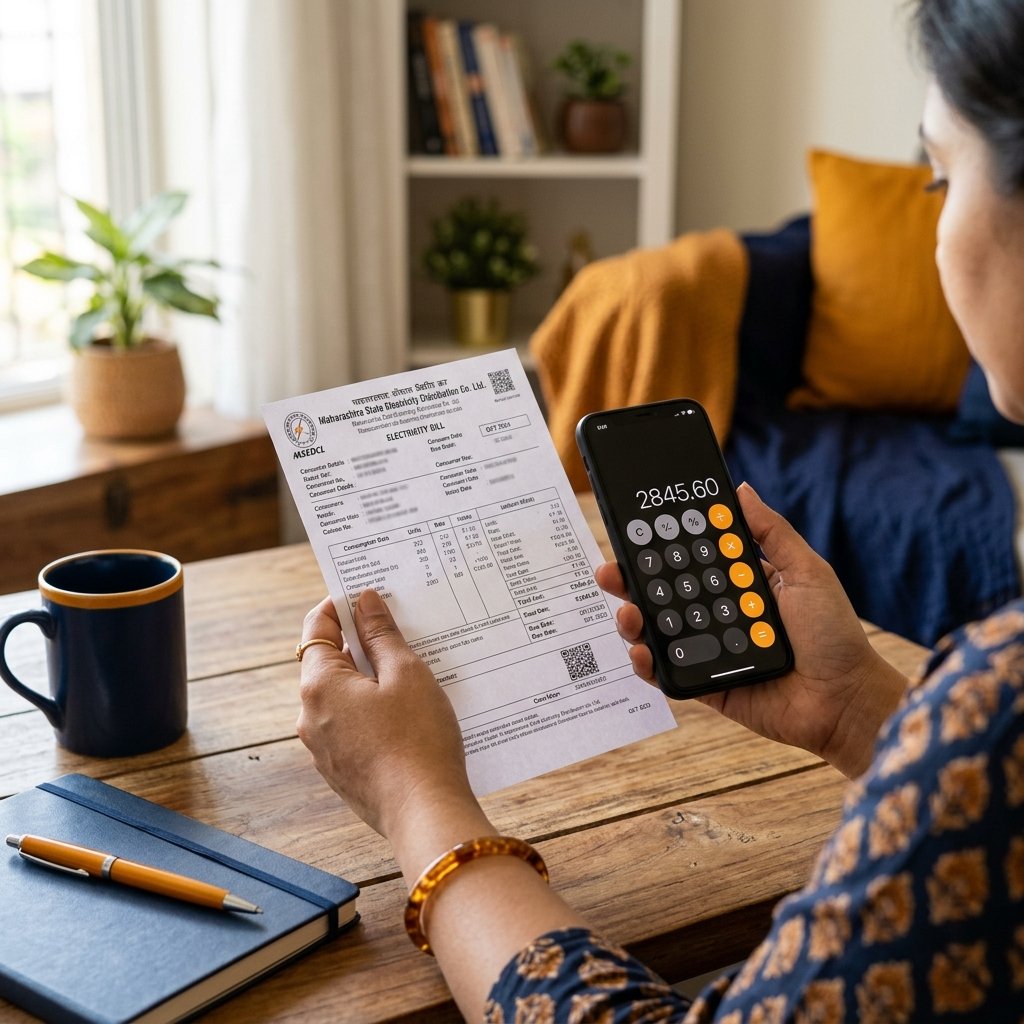
Receiving an unusually high electricity bill can be a frustrating experience. You look at the "Total Units Consumed" and try to multiply it by the rate you heard on the news, but the final amount on the paper is always higher than your math.
Why? Because calculating an electricity bill in India involves a telescopic slab system, fixed charges, and government duties. In this guide, we will break down exactly how your bill is calculated step-by-step so you can verify if you are being charged correctly.
Quick Answer
To calculate your bill from units: Break your units into state-defined slabs (e.g., first 100 units at ₹4, next 100 at ₹6). Add these energy charges together. Then, add your monthly Fixed Charge (based on kW load) and apply the percentage Electricity Duty/Tax to the total. This gives you your final bill.
Key Takeaways
- Your bill is NOT a flat rate multiplied by total units.
- India uses a "Slab System"—heavy users pay a much higher rate per unit.
- Fixed Charges must be paid even if you consume 0 units.
- State taxes (Duty) are calculated as a percentage of your Energy Charge.
Step 1: Understand Your Units (kWh)
Your total monthly consumption is measured in units. 1 Unit is equal to 1 kWh. Your electricity board finds this number by taking the current reading on your meter and subtracting the reading from the previous month.
Example: Current Reading (5500) - Last Month Reading (5250) = 250 Units.
Step 2: Calculate the Energy Charge (The Slab System)
This is where most people get confused. Electricity providers penalize high consumption to encourage energy saving. They do this by dividing your units into "slabs."
Let's calculate the cost for 250 units using a standard hypothetical slab structure:
| Tariff Slab | Units in Slab | Rate / Unit | Calculation |
|---|---|---|---|
| 0 to 100 units | 100 units | ₹4.00 | 100 × 4 = ₹400 |
| 101 to 200 units | 100 units | ₹6.00 | 100 × 6 = ₹600 |
| 201 to 300 units | 50 units | ₹8.00 | 50 × 8 = ₹400 |
| Total Energy Charge | ₹1,400 | ||
Step 3: Add Fixed Charges
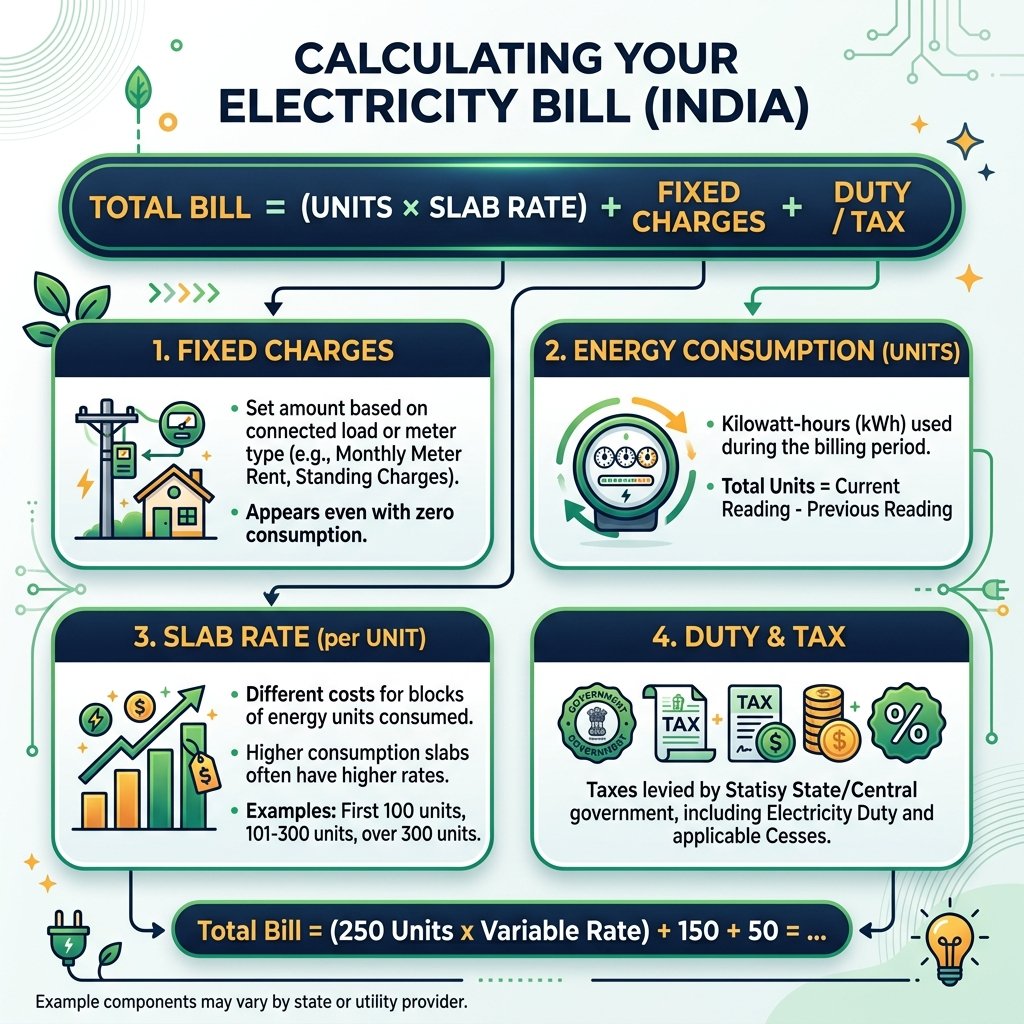
The energy charge (₹1,400) is just for the electricity you used. Now you must add the Fixed Charge. This is a rental fee for the cables, transformers, and the connection itself.
Fixed charges are based on your Sanctioned Load (measured in kW). If your home has a sanctioned load of 2 kW, and the provider charges ₹100 per kW, your fixed charge is ₹200.
Step 4: Add Taxes and Duties
State governments levy a tax on electricity consumption called "Electricity Duty." This is usually a percentage of your Energy Charge (not the fixed charge).
If the electricity duty in your state is 10%, you will pay 10% of ₹1,400, which equals ₹140.
The Final Bill Formula
Final Bill = Energy Charge + Fixed Charge + Duty
Final Bill = ₹1,400 + ₹200 + ₹140 = ₹1,740

Common Mistakes to Avoid
- Ignoring the FAC: Many states have a Fuel Adjustment Charge (FAC) which changes every month based on coal prices. This can subtly increase your bill.
- Upgrading load unnecessarily: If you upgrade your sanctioned load from 2kW to 5kW to buy a new AC, your Fixed Charges will permanently double or triple.
- Jumping a slab: If you consume 199 units, you stay in a cheaper slab. If you consume 205 units, those extra 6 units are billed at a much more expensive rate. Monitor your usage closely!
Frequently Asked Questions
How is the electricity bill calculated in India?
It is calculated by multiplying your consumed units by your state's specific slab rate, then adding fixed charges based on your connected load, plus government electricity duty/taxes.
What is a tariff slab in an electricity bill?
A slab is a pricing tier. For example, the first 100 units might cost ₹4 per unit, but the next 100 units might cost ₹6 per unit. The more you consume, the higher the rate you pay.
Why is my bill higher even if my units are the same?
If your units are the same but the bill is higher, your state government may have increased the Fuel Adjustment Charge (FAC) or the electricity duty tax.
What is a fixed charge?
A fixed charge is a mandatory monthly fee you pay to the electricity board to maintain the infrastructure, based on your home's total sanctioned load capacity in kW.
How do I calculate the cost of 250 units?
If slab 1 (0-100) is ₹4, slab 2 (101-200) is ₹6, and slab 3 (201-300) is ₹8: (100×4) + (100×6) + (50×8) = ₹400 + ₹600 + ₹400 = ₹1400 in energy charges, plus fixed fees and tax.
Do all states in India have the same unit rate?
No. Electricity falls under the state list in India. Every state's regulatory commission decides its own slab rates, fixed charges, and taxes.
Is 1 unit equal to 1 kWh?
Yes. 1 unit of electricity on your bill is exactly 1 Kilowatt-hour (kWh).
How can I calculate my bill instantly?
You can use our free Electricity Bill Calculator tool, enter your units and local rate, and it will give you an instant estimate.
Too Much Math? Use Our Calculator
Skip the manual calculation. Just enter your total units and your state's average rate into our free tool to get an instant breakdown of your bill.
Calculate My Bill Now