kVAh vs kWh in Your Electricity Bill: The Ultimate Guide
If you own a shop, factory, or commercial property in India, you've likely noticed that your electricity bill is calculated in kVAh rather than the standard kWh used for residential homes.
Many business owners are confused by this and feel they are being overcharged. What exactly is the difference, and why does the electricity board care so much about your "Power Factor"?
The Quick Answer
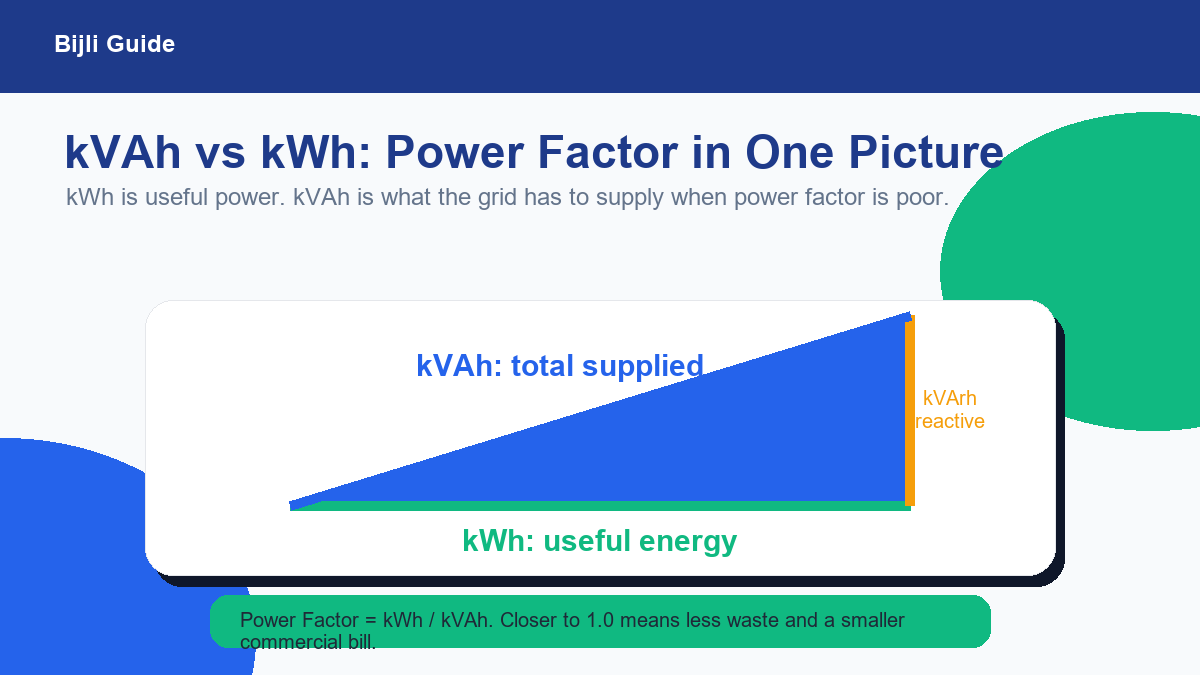
kWh is the power your appliances actually use (Active Power). kVAh is the total power the grid had to supply to make your appliances work (Apparent Power). Because appliances have magnetic losses, kVAh is always higher than kWh. Electricity boards charge commercial properties in kVAh to penalize them for having inefficient electrical systems.
For businesses, this is a billing issue
In a home, kWh is usually enough to understand the bill. In shops, workshops, hotels, cold storage units, and factories, poor power factor can increase billed kVAh even when useful work has not increased.
If your commercial bill has suddenly risen, compare kWh, kVAh, and power factor across two months before blaming only the unit rate.
The Beer Glass Analogy (Power Factor)
To understand the difference, engineers use the famous "Glass of Beer" analogy:
- The Liquid Beer (kWh): This is the actual electricity that does useful work, like spinning a motor or lighting a bulb. This is your Active Power.
- The Foam (kVArh): This is "wasted" energy. It is required to create magnetic fields in motors and transformers, but it does no actual physical work. This is your Reactive Power.
- The Whole Glass (kVAh): This is the total volume of the glass—the liquid plus the foam. This is the Apparent Power that the electricity company had to generate and send through the power lines.
The ratio of Liquid Beer (Useful Power) to the Whole Glass (Total Power) is called the Power Factor (PF).
Power Factor (PF) = kWh ÷ kVAh
Why Commercial Bills use kVAh
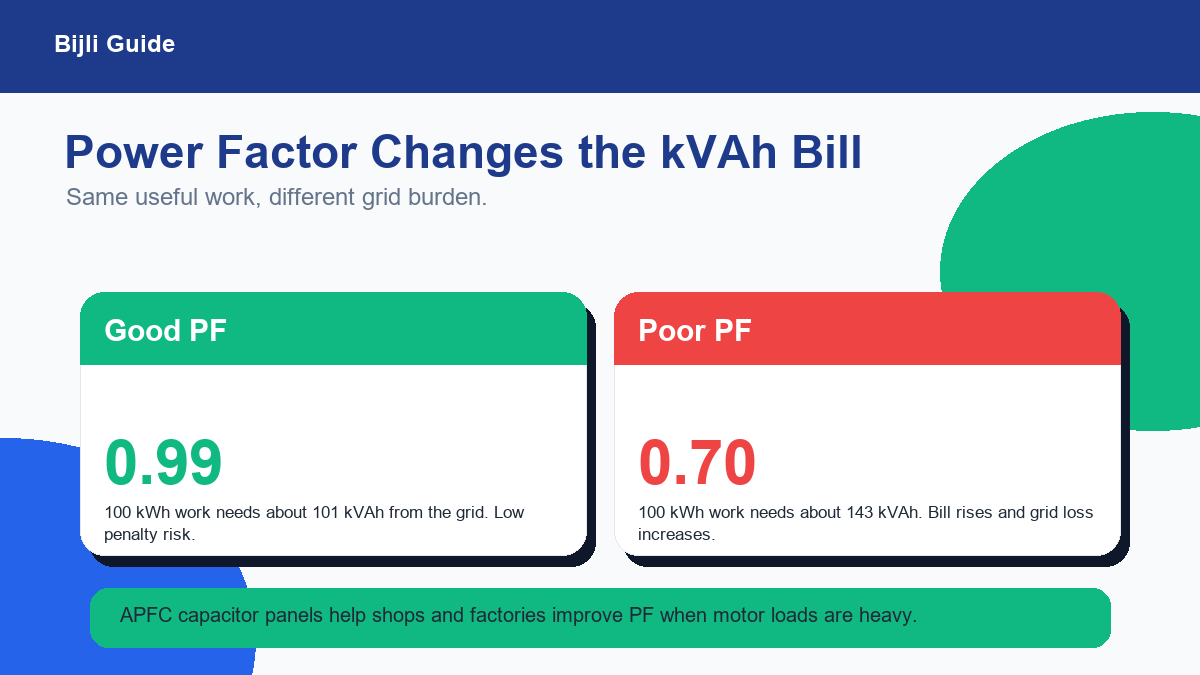
If you run a factory with hundreds of heavy induction motors, your system creates a lot of "Foam" (Reactive Power). Your Power Factor drops to, say, 0.70.
If you need 100 kWh of actual work done, but your PF is 0.70, the electricity company has to push 142 kVAh (100 ÷ 0.70) of power through their lines to get it to you.
This massive amount of extra power overheats transformers and burns out city grid lines. To stop this, distribution companies (DISCOMs) bill commercial users for the entire glass (kVAh). If you have too much foam, your bill skyrockets.
How to Reduce Your kVAh Bill
You can bring your kVAh down so it almost perfectly matches your kWh by installing an APFC (Automatic Power Factor Correction) Panel. These panels use capacitors to supply the "foam" locally, so the city grid doesn't have to. A perfect Power Factor of 0.99 means your kVAh and kWh will be identical, saving you thousands of rupees.
Why Don't Homes Pay in kVAh?
Domestic households (residential connections) do not use massive induction motors or industrial welders. Most home appliances (LED lights, TVs, laptops) have a Power Factor very close to 1.0.
Because domestic homes don't strain the grid with bad power factors, DISCOMs simply bill homes using the straightforward kWh metric (1 Unit = 1 kWh).
Frequently Asked Questions
What is the difference between kWh and kVAh?
kWh (Kilowatt-hour) is the actual power your appliances consume to do work (like spinning a fan). kVAh (Kilovolt-ampere hour) is the total power the electricity grid had to supply to your house. Because appliances are not 100% efficient, kVAh is always slightly higher than kWh.
Why are commercial bills charged in kVAh instead of kWh?
Electricity boards charge commercial properties in kVAh to force them to maintain a good 'Power Factor'. If a factory has a bad power factor, it draws much more kVAh from the grid than the kWh it actually uses, placing immense strain on the power grid.
How can I reduce my kVAh bill?
You can reduce your kVAh billing by improving your Power Factor (bringing it closer to 1.0). This is usually done by installing an APFC (Automatic Power Factor Correction) capacitor panel.