Does Charging an EV at Home Push You Into a Higher Tariff Slab?
Buying an Electric Vehicle (EV) is supposed to save you money. However, many new EV owners in India are experiencing "bill shock" after their first month of home charging.
The problem isn't that EVs use too much electricity. The problem is how Indian electricity distribution companies (DISCOMs) structure their billing slabs.
Use marginal cost, not average cost
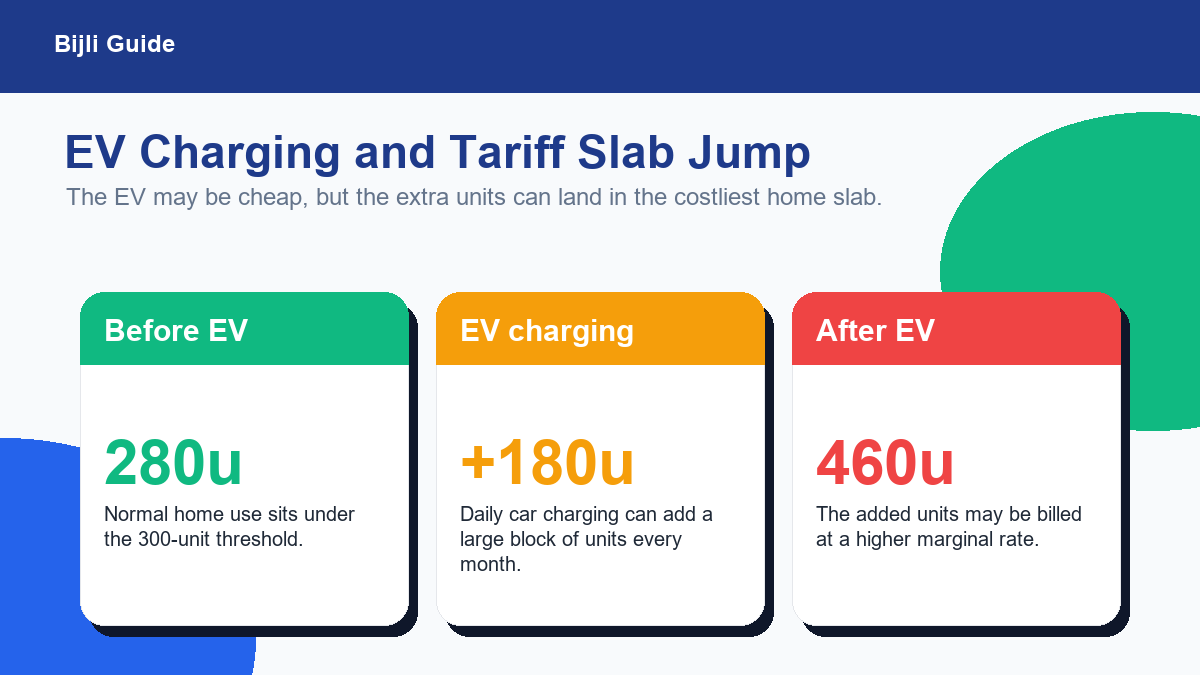
Your bill may show an average cost per unit, but an EV usually adds the next block of units at the top of your slab. If your home already uses 280 units and your car adds 180 units, most of the EV charging may be billed in the higher slab.
This does not make EVs expensive. It simply means the saving calculation should use the rate for the extra units, not the average rate across the whole household.
The "Telescopic Slab" Trap
Almost all states in India use a telescopic billing system. This means the more electricity you consume, the higher the rate you pay for the top units.
For example, let's look at a simplified residential tariff structure:
- 0 to 100 units: ₹5 per unit
- 101 to 300 units: ₹8 per unit
- 301 to 500 units: ₹11 per unit
- Above 500 units: ₹14 per unit
The EV Car Scenario
Imagine your house currently consumes 280 units a month running fans, a fridge, and lights. You are comfortably sitting in the ₹8 slab.
Now, you buy a Tata Nexon EV. Commuting daily adds roughly 180 units to your monthly consumption.
Your new total consumption is 460 units.
You have now crossed the 300-unit threshold. Those extra 160 units (from 301 to 460) will be billed at the punishing ₹11 per unit rate. Your EV isn't being charged at your old average of ₹8; the new load is essentially being charged at the premium rate!
The Solution: Dedicated EV Meters
To solve this, the Indian government mandated that DISCOMs offer dedicated EV charging meters. These meters bypass your home's telescopic slabs and charge a flat, subsidized rate (usually between ₹6 and ₹7.50 per unit depending on the state).
How to Apply for a Dedicated EV Meter
If your EV is pushing your home bill into the highest luxury slabs (above 500 units), getting a separate EV meter is highly recommended.
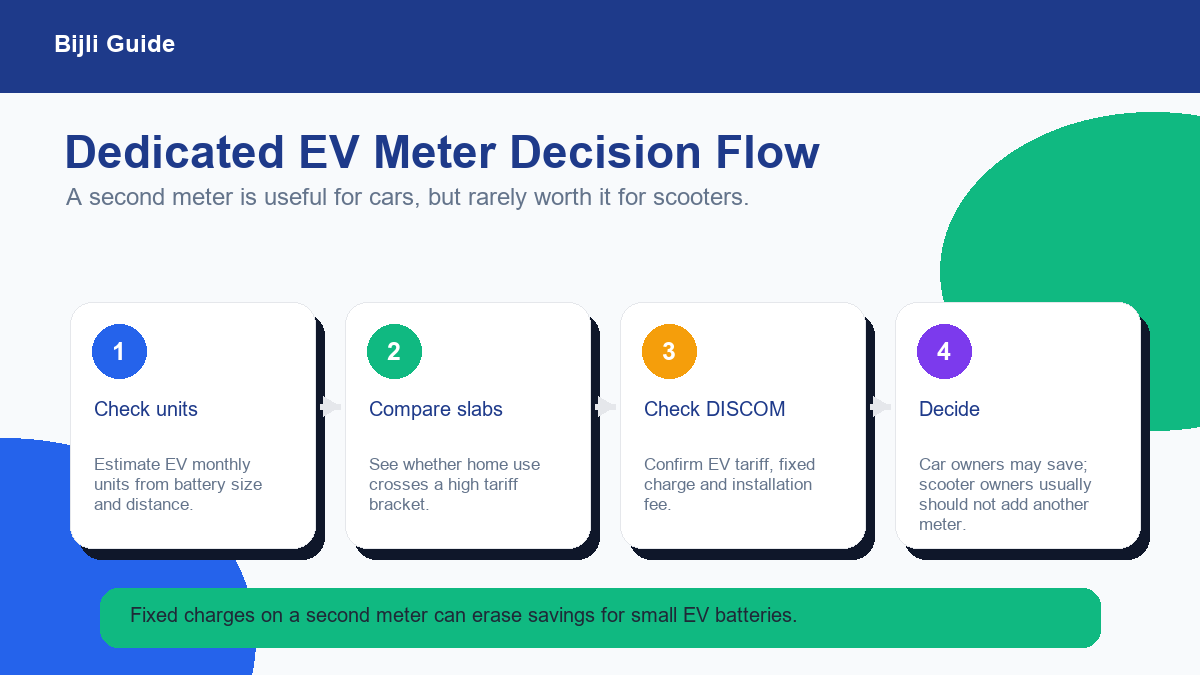
- Verify your DISCOM policy: Check if your provider (MSEDCL, BESCOM, Tata Power, etc.) offers EV-specific domestic tariffs.
- Submit an application: You can usually apply online via your DISCOM portal under "New Connection" and select "EV Charging" as the category.
- Installation: The DISCOM will install a second meter next to your primary home meter. You will wire your EV wall-box charger directly to this new meter.
- Two Bills: You will now receive two electricity bills: one for your home, and one flat-rate bill for your car.
Should Electric Scooter Owners Get an EV Meter?
No. Electric scooters (like the Ola S1 Pro or Ather 450X) have very small batteries. They only consume about 20 to 30 units a month.
This tiny increase is very unlikely to push your household into a punishing new tariff slab. Furthermore, a separate EV meter comes with its own monthly "Fixed Charges" (often ₹150 - ₹200/month). For a scooter, the fixed charges of the second meter would cost more than the electricity you save!
Frequently Asked Questions
Will charging an EV car increase my electricity rate?
Yes, if you charge an electric car on your regular home meter, it can add 150 to 250 units to your monthly consumption. In states with telescopic slabs (like Maharashtra or UP), this can push your entire bill into a higher, more expensive per-unit bracket.
Can I get a separate electricity meter just for my EV?
Yes. Many state distribution companies (like MSEDCL in Maharashtra and BESCOM in Karnataka) allow you to apply for a dedicated EV charging meter, which offers a flat, subsidized rate specifically for EV charging.
Should I get a separate meter for my electric scooter?
No. Electric scooters (like Ola or Ather) only consume about 20 to 30 units a month. This is too small of an increase to justify the installation and fixed charges of a separate EV meter.