1 Unit Electricity Cost in Rajasthan (JVVNL, AVVNL) 2026 Tariff
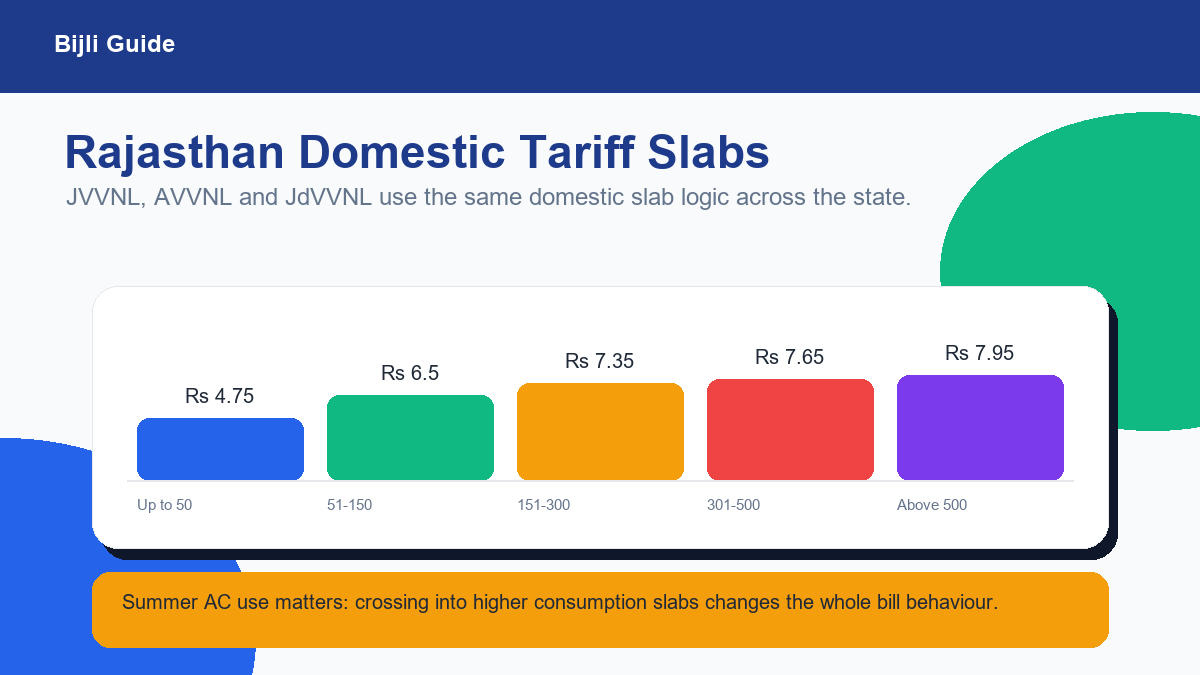
Rajasthan is divided into three major power distribution zones: JVVNL (Jaipur), AVVNL (Ajmer), and JdVVNL (Jodhpur). Regardless of where you live—from the capital city of Jaipur to the desert towns of Jodhpur—the domestic tariff slabs are completely identical.
Let's look at the official 2026 RERC (Rajasthan Electricity Regulatory Commission) slabs to see exactly how much you are paying for electricity in the desert state.
The Quick Answer
In Rajasthan, the base domestic electricity cost ranges from ₹4.75 to ₹7.95 per unit. However, due to state government schemes, consumers using under 100 units a month usually pay ₹0.
How to use these slabs in real life
If your home stays below 100 units, the subsidy story matters more than the tariff table. Once air conditioners, desert coolers, or water pumps push the bill above that range, the slab rate and fixed charge become much more important.
For the most accurate estimate, compare two bills from different seasons. A January bill and a June bill often reveal the exact appliance or habit that is moving the household into a higher slab.
Rajasthan Domestic Tariff Slabs (2026)
Rajasthan uses a "Telescopic" structure based on total monthly consumption. This means if you use a lot of electricity, the price for every unit increases.
| Monthly Consumption Slab | Base Energy Charge (₹ / Unit) | Fixed Monthly Charge (₹) |
|---|---|---|
| Up to 50 Units | ₹ 4.75 | ₹ 230 / conn |
| 51 to 150 Units | ₹ 6.50 | ₹ 275 / conn |
| 151 to 300 Units | ₹ 7.35 | ₹ 275 / conn |
| 301 to 500 Units | ₹ 7.65 | ₹ 345 / conn |
| Above 500 Units | ₹ 7.95 | ₹ 400 / conn |
The 100 Free Units Scheme
Under the state's Mukhyamantri Nishulk Bijli Yojana, domestic consumers receive the first 100 units entirely free. If your bill is 90 units, your payable amount is zero. If you consume 200 units, the first 100 are heavily subsidized, and you only pay full price for the remaining 100 units. Additionally, the Fuel Surcharge (FPPCA) is waived for up to 200 units of consumption.
Why Do Rajasthan Bills Spike in Summer?
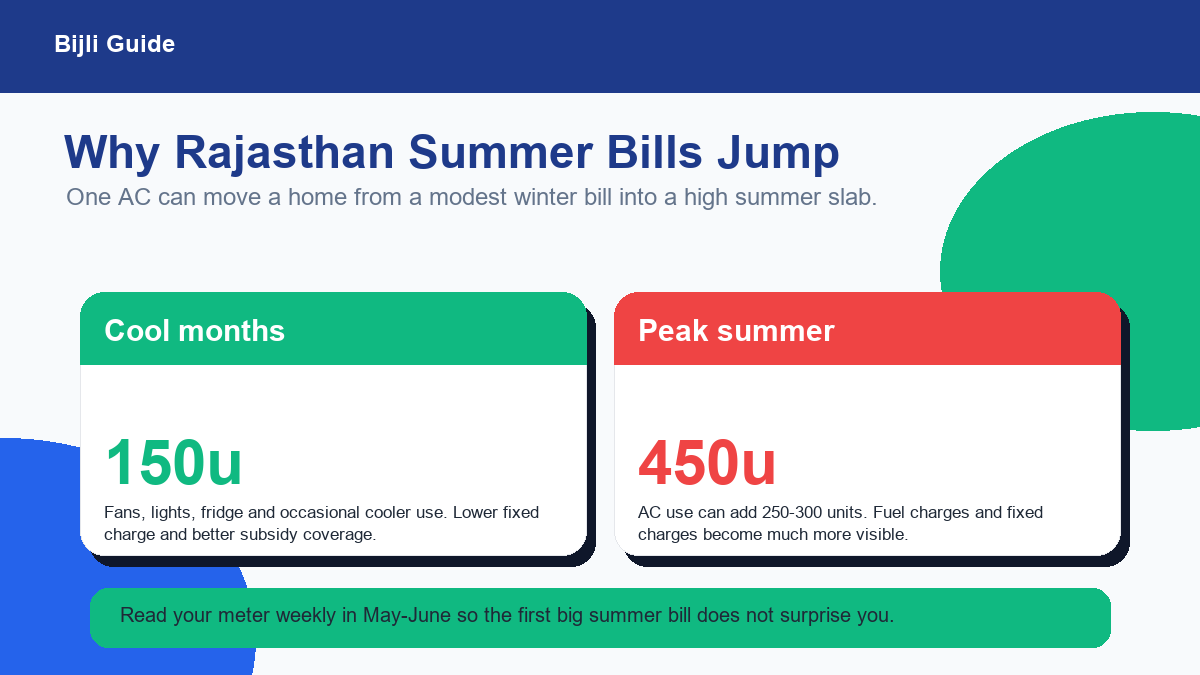
Summers in Rajasthan are brutal, frequently crossing 45°C. When a household runs an Air Conditioner (AC), their monthly consumption easily skyrockets from 150 units to 450 units.
At 450 units, you lose the benefits of the free-electricity scheme. You are suddenly paying the premium ₹7.65 per unit energy charge, plus heavy fuel surcharges and a massive ₹345 Fixed Charge. This causes the summer electricity bill to effectively quadruple compared to the winter bill.
Frequently Asked Questions
What is the cost of 1 unit of electricity in Rajasthan?
For domestic consumers in Rajasthan, the energy charge ranges from ₹4.75 for the first 50 units, up to ₹7.95 for consumption above 500 units.
Does Rajasthan have a free electricity scheme?
Yes. The Rajasthan government previously announced 100 units of free electricity for domestic consumers under the Mukhyamantri Nishulk Bijli Yojana, waiving all fuel surcharges and fixed costs for the first 100 units.
Who supplies electricity in Jaipur?
Jaipur is supplied by JVVNL (Jaipur Vidyut Vitran Nigam Limited), which follows the standard tariff slabs approved by the Rajasthan Electricity Regulatory Commission (RERC).